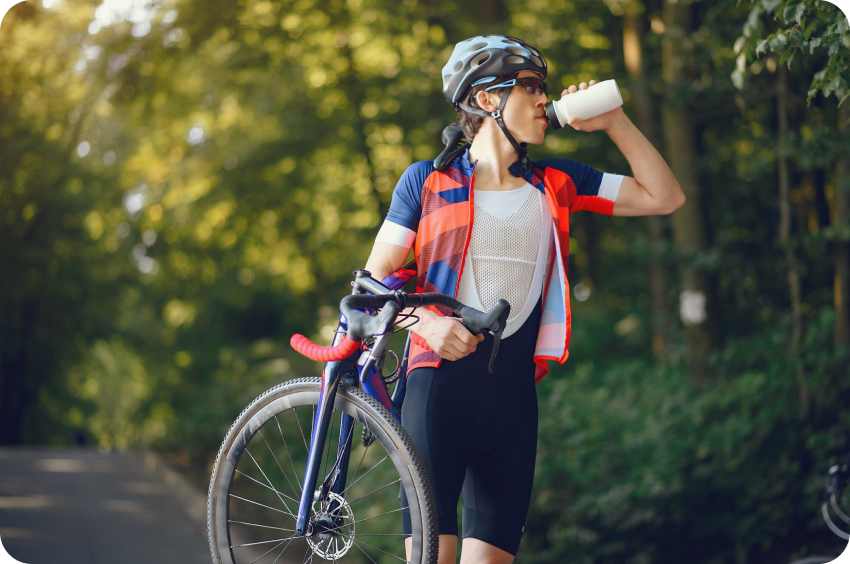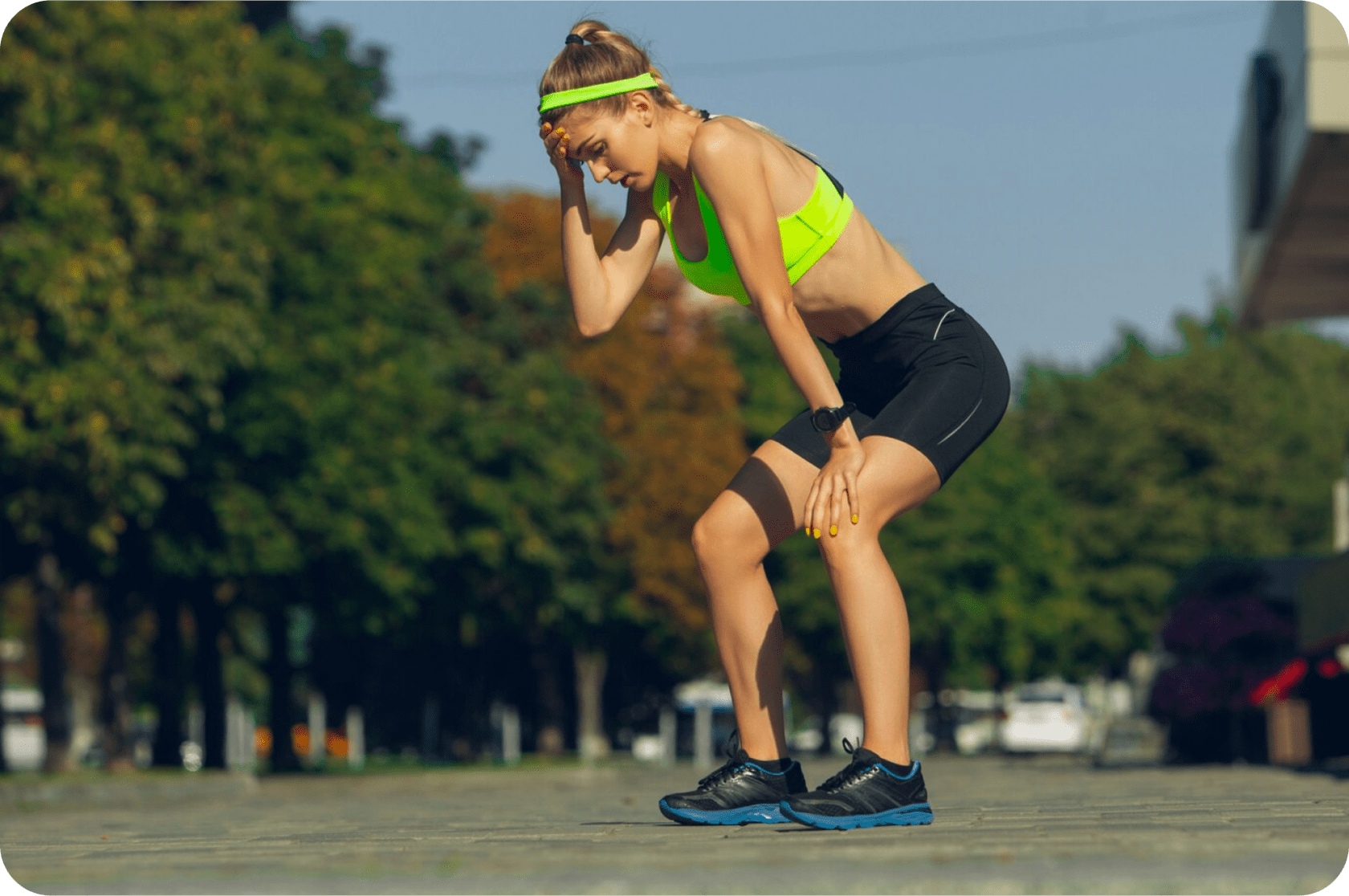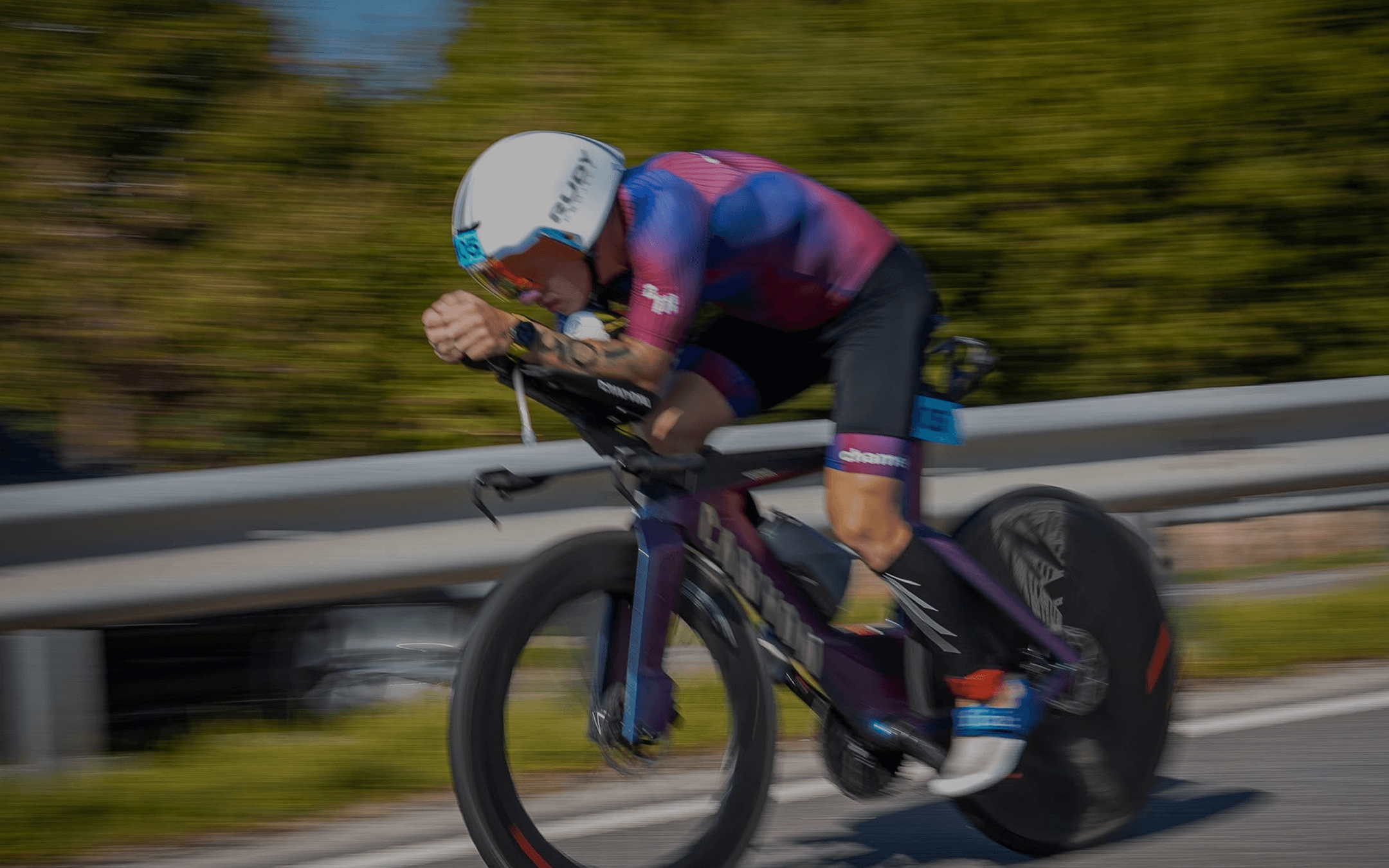


If you’ve been for a while, you probably know the feeling that happens in the middle of your long-distance ride: your legs turn to concrete, your brain goes foggy, and, almost immediately, your powers just leave you. You start doing strange maths about how far you still have to go. That’s the bonk, and once it arrives, it doesn’t leave quietly.
The thing is, it doesn’t have to happen.
Fuelling on long rides is sometimes called the fourth discipline in triathlon, and it’s earned that title. You can have great fitness and still destroy a ride if you eat too little, too late, or the wrong things entirely.
I’ve done it more times than I want to admit. A long training block a couple of summers ago humbled me completely. I know it happened because my nutrition plan was basically nonexistent. But since then, a couple of things have changed in my long bike ride nutrition strategy.
That’s what I want to share in this brief post.
- Here, I cover the following aspects:
- Why do our bodies run out of fuel in the first place?
- How much one actually needs to eat and drink per hour.
- What to eat during a long ride and when.
- How to build a gut that can handle race-day demands.
It’s practical, it’s based on real research, and it works.
The Science Behind Cycling Nutrition: Glycogen, Glucose, and Your Gut
Your body runs primarily on glycogen during hard efforts. Glucose is stored in your muscles and liver. The problem is you can only carry so much of it. Most cyclists have enough on board for roughly 90 minutes of moderate-to-hard riding. After that, if you haven’t been replacing it, you’re borrowing against nothing.
That’s the bonk. Not a weakness, just basic biology.
Why Your Gut Has a Ceiling
So the answer is to keep feeding the engine. But here’s where it gets interesting — your gut has a limit on how fast it can absorb carbohydrates, and if you push past it, you’ll know about it:
- Bloating and that horrible sloshing feeling mid-ride.
- Nausea at the worst possible moment.
- GI cramps that force you to back off completely.
The reason this happens comes down to two transport proteins in your small intestine, each working a completely separate pathway:
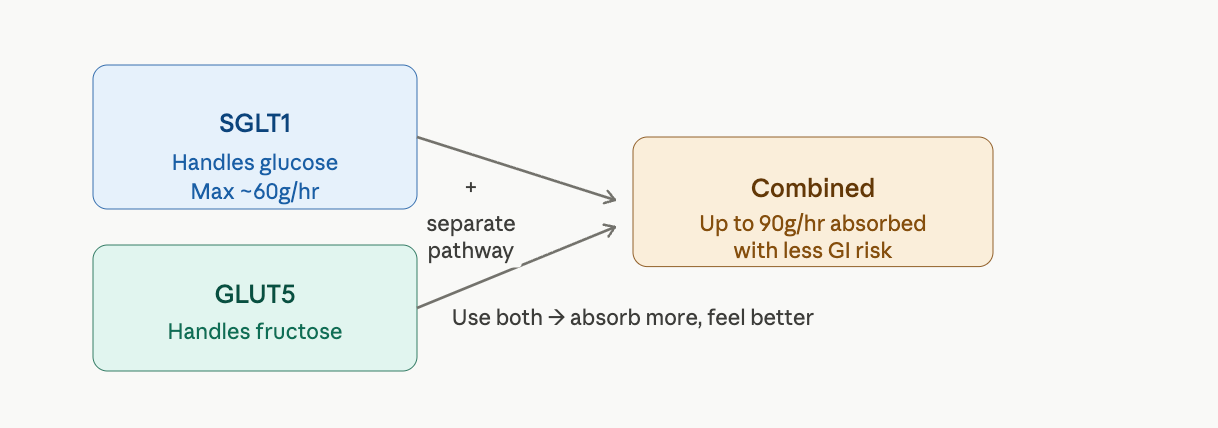
Use both pathways together, and you can absorb up to 90 grams of carbohydrate per hour without overwhelming either channel. That’s the principle behind products like Maurten and SiS Beta Fuel. They combine maltodextrin (a glucose chain) with fructose specifically to exploit both transporters at once.
Researcher Asker Jeukendrup has done some of the most cited work in this area. His findings point to the same conclusion: athletes using mixed carbohydrate sources perform meaningfully better than those relying on glucose alone.
On rides over two and a half hours, you need to be taking in carbohydrates from the start. Not when you feel empty, but on a schedule. And if you want to hit the higher end of that absorption range, the source of carbs also matters.
A single-sugar gel gets you to around 60 grams per hour. An energy gel or sports drink that combines glucose and fructose (like Maurten or SiS Beta Fuel) allows you to absorb up to 90 grams per hour, with less GI risk.
Your gut, it turns out, is just as trainable as your legs. But we’ll get to that.
Role of Hydration and Electrolytes in Your Cycling Nutrition Strategy
On a long ride, water alone isn’t enough. And in some cases, drinking too much of it can actually cause problems. Let’s get into it in more detail.
Hyponatremia is what happens when sodium levels in your blood drop too low, usually from drinking large amounts of plain water without replacing the salt lost through sweat.
It’s more common than most cyclists realize, and its symptoms, such as nausea, headache, confusion, and swelling, are easy to mistake for dehydration. In this case, the fix isn’t more water. But sodium.
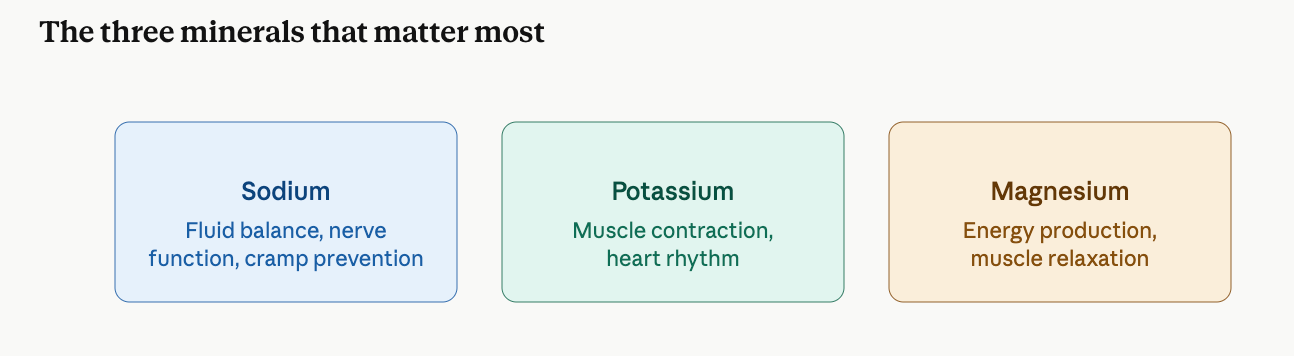
Sodium is the one to prioritize on the bike. It’s lost in the highest quantities through sweat, and it’s what keeps fluid in the right places. Most electrolyte drinks and tabs include it, but check the label, because the range varies widely between products.
How Much Should You Drink During Your Long Bike Ride?
A simple way to find your personal sweat rate is the weigh-in test. You’ve probably known it, but just in case, here’s how you do it:
- Weigh yourself before the ride (no clothes, after using the bathroom).
- Ride for one hour, drinking as normal and noting how much fluid you consumed.
- Weigh yourself again immediately after.
- Every kilogram lost equals roughly one liter of sweat.
Do this a few times across different conditions (I do it 2-3 times during the season), and you’ll have a reliable personal baseline.
As a general starting point, aim for 500–750ml of fluid per hour. But in the heat, that changes.
Above 25°C, your sweat rate increases significantly, and so does your sodium loss. To eliminate that loss, you want to push fluids to 750–1000ml per hour and increase your sodium intake alongside it. I usually do that with an electrolyte drink or high-sodium tabs.
| Temperature | Fluid target | Sodium priority |
|---|---|---|
| Below 15°C | 400–500ml/hr | Moderate |
| 15–25°C | 500–750ml/hr | Standard |
| Above 25°C | 750–1000ml/hr | High — increase sodium |
The goal is to finish a ride within 1–2% of your starting body weight. If you lose more than that, chances are, your performance drops noticeably. Gain weight mid-ride, and you’ve been over-drinking, which brings us back to hyponatremia. So, keeping this balance is crucial.
How Many Carbs Per Hour? A Long Ride Nutrition Strategy by Duration
This is the question most cyclists search for, and the honest answer is: it depends on how long you’re riding and how hard. But the ranges are well established, and once you know them, planning becomes straightforward.
| Duration | Intensity | Carbs/hr | Fuel type | Example products |
|---|---|---|---|---|
| 1–2 hrs | Recovery / Z2 | 30–45g | Electrolyte drink or banana | High5 Zero, fresh fruit |
| 2–4 hrs | Endurance | 60–75g | Gels, chews, liquids | SiS gels + Torq chews |
| 4+ hrs | Race / Epic | 80–90g+ | Liquid nutrition + real food | Maurten 320 + rice cakes |
For shorter rides, your carbohydrate stores have enough glycogen to carry most of the load. Once you cross the two-hour mark of your endurance ride, you need to be actively replacing fuel. And at four hours and beyond, the combination of liquid nutrition and real food becomes both practical and necessary.
When Exactly Should You Eat and Drink During an Endurance Ride?
Here, I must say that your nutrition must be adapted, so you need to check what works best for you. I will share what, for me, is a solid nutrition strategy that you can customize to your needs:
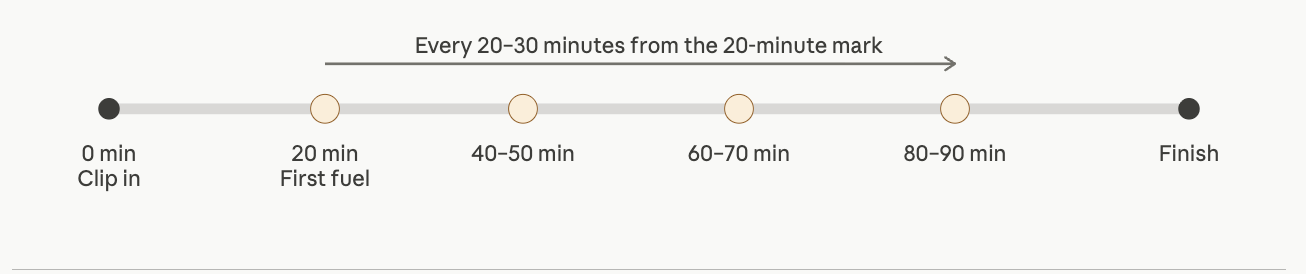
- Start fueling at the 20-minute mark, not when you feel hungry. Hunger is a lagging signal when cycling long distances. By the time it arrives, your glycogen stores are already taking a hit.
- From there, eat every 20–30 minutes on a schedule.
- Set a reminder on your GPS if that helps. Small, consistent amounts are easier on your gut than large portions every hour, and they keep blood glucose more stable throughout the ride.
Real Food vs Gels on Long Rides: What to Use and When
Both work well. The question is when each one makes sense.
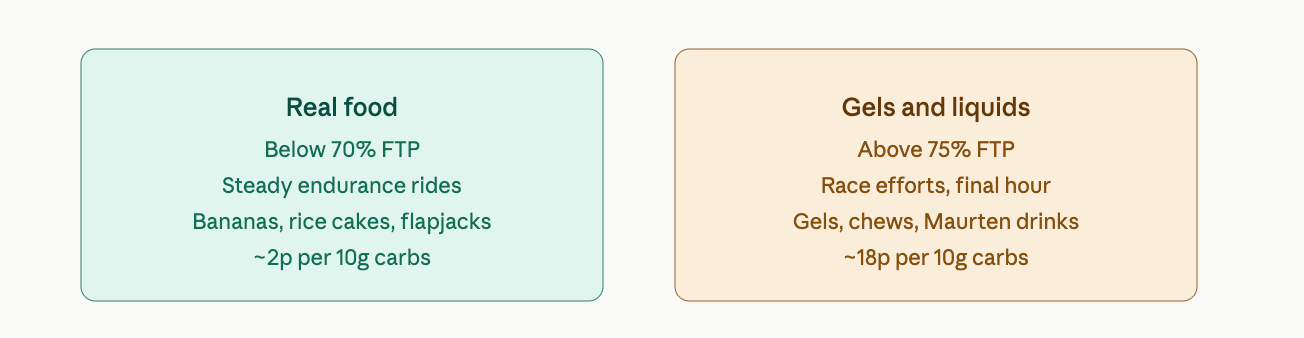
At lower intensities, like below around 70% of your FTP, your gut is relatively relaxed, blood flow to your digestive system is reasonable, and real food is perfectly fine.
A banana, a rice cake, or an energy bar will do the job. These digest well, plus, they’re much cheaper than gels.
Once intensity rises above 75% FTP, or you’re in the final hour of a race, the calculation shifts. Blood is being redirected to your working muscles, digestion slows, and solid food becomes harder to process. That’s when gels, energy chews, and liquid nutrition earn their place as they’re designed to absorb fast with minimal digestive load.
One more thing I would like to mention is that flavor fatigue is real. After three hours of the same sweet gel, your body starts resisting it because your brain is done with the taste.
I know it too well, and for me, mixing real food into longer rides isn’t just a budget decision. It keeps eating feel tolerable when everything else is hard.
Training Your Gut for Long Distance Ride Nutrition (Most Cyclists Skip This)
Here’s the thing nobody told me when I first started taking nutrition seriously: your gut needs training just as much as your legs do.
You can have the most balanced diet ever, and a perfect fuelling plan in theory, and still end up doubled over at kilometer 120 because your digestive system simply isn’t used to processing carbohydrates at that rate while under physical stress.
Most cyclists, including me, find out the hard way. Sometimes, during training rides, sometimes, on race day, with a gel in hand and nowhere to go.
The good news is that gut adaptation is well-documented and genuinely achievable. Dr. Asker Jeukendrup, whose research on carbohydrate absorption has pretty much shaped how endurance sports nutrition is understood today, has shown that consistent exposure to higher carbohydrate intake during training leads to measurable improvements in both absorption capacity and comfort over time.
In simple words: the gut adapts to higher carbohydrate intake over time — absorbing more, more efficiently. That’s why it’s crucial to practice your fuelling in training, not on race day.
A common long ride nutrition strategy might look like this:
This example is based on a 4-hour endurance ride at moderate intensity — the kind of session that shows up regularly in Ironman and 70.3 build blocks.
This example is based on a four-hour endurance ride at moderate intensity.
Hour 1 (0–60 min)
- First 20 minutes: water only, let your body settle
- 20 min: first gel or banana
- 40 min: switch to electrolyte drink, sip every 10–15 min
- Target: 40–45g carbs, 500ml fluid
Hour 2 (60–120 min)
- 60 min: gel
- 80 min: rice cake, chew, or real food
- Electrolyte drink ongoing
- Target: 60–70g carbs, 500–600ml fluid
Hour 3 (120–180 min)
- 120 min: dual-source gel (glucose + fructose)
- 140 min: real food — bar, rice cake, or banana
- Keep sodium intake up, especially in the heat
- Target: 70–80g carbs, 500–750ml fluid
Hour 4 (180–240 min)
- Gels every 20–25 min — real food steps aside
- Switch to liquid nutrition if your stomach feels the load
- Optional: caffeine gel in the final 30 min if practiced before
- Target: 80–90g carbs, 500–750ml fluid
A few things worth noting about this plan (some of these aspects I’ve already mentioned, just to highlight once again, as these matter).
- First, carb intake increases as the ride progresses because your glycogen stores are drawing down, and the effort of staying on pace rises. Ironman-certified coach Conrad Goeringer recommends targeting 250–400 calories of carbs per hour on the bike, alongside 500–1000mg of sodium, figures that align closely with what’s shown here.
- Second, real food features in hours two and three, then gives way to gels in the final hour. The bike is a great place to take in more fuel since it’s easier to eat and digest than during a run. Use that window well.
- Third, the caffeine gel in hour four is optional but strategic. If you use it, keep it consistent with what you’ve practiced, and make sure it sits on top of your carbohydrate intake, not instead of it.
Keep in mind that every athlete is different. This plan gives you a solid starting framework, but your sweat rate, gut tolerance, and intensity will all shape what the final version looks like for you.
Final Thoughts on Endurance Cycling Nutrition
Long ride nutrition isn’t complicated, but it does require intention and a strategic approach. Just like everything else in triathlon, honestly.
The athletes who get it right aren’t necessarily the ones with the most expensive products. From what I see, they’re the ones who’ve practiced and built a system that works for their body.
I would recommend starting with the basics: eat early, eat consistently, use the right carb sources for the intensity, and don’t ignore your electrolytes. Then layer in the details, such as gut training, sweat testing, and progressive carb loading, as you get more comfortable with the process.
It will take some trial and error. You’ll have a ride where you get it wrong and feel it. That’s fine. Every athlete has those days. What matters is that you learn from them and adjust.
And if you’d rather not figure it all out alone, that’s what TriWorldHub is for. On the platform, you can connect directly with experienced coaches and sports nutritionists who can build a fuelling plan around your specific event, body, and goals. It’s free to join and takes just a few minutes.
Fuel well. Ride strong.
FAQs
How many carbs do I need on a long ride?
Aim for 60–90g of carbohydrates per hour on rides longer than 2.5 hours. For rides under two hours, 30–45g per hour is usually enough.
The exact amount depends on intensity — the harder you ride, the more glycogen you burn.
How do I stop stomach problems on long bike rides?
Use liquid calories at higher intensities, reduce fiber intake 24 hours before long rides, and gradually build your carb intake during training.
Avoid introducing new gels or foods on race day, and be cautious with high-fructose products early in the ride.
What if I have a nervous stomach before or during a ride?
Stick to liquid calories when possible, as they are easier to digest.
Take small sips every 10–15 minutes instead of large amounts at once to reduce stomach stress.
Can I just use coffee for energy on long rides?
No. Caffeine is not a fuel source — it doesn’t provide carbohydrates.
It can reduce perceived effort and improve focus, especially later in a ride, but it should be used alongside a proper fueling plan, not instead of it. A typical effective dose is 3–6 mg per kg of bodyweight.
Should I still eat on long rides if I’m trying to lose weight?
Yes. Under-fueling during long rides reduces performance, slows recovery, and can increase injury risk.
It’s better to fuel your ride properly and create any calorie deficit through overall daily nutrition, not by skipping on-bike fueling.
What is the recovery window after a long ride?
The first 30–60 minutes after finishing is when your body is most effective at restoring glycogen.
Aim for about 20–25g of protein and 60–80g of carbohydrates as soon as possible. Options like chocolate milk, a rice-and-egg bowl, or a recovery drink work well.