


If you’re sitting here wondering whether remote triathlon coaching is worth it, or whether you’re just paying for a spreadsheet and a monthly call, that’s a fair question. I asked the same thing. So let me try to give you a straight answer, based on what I’ve seen and what other athletes I’ve talked to say.
The short version: for a lot of triathletes, especially those who don’t live in a major hub, online triathlon coaching isn’t a lesser version of real coaching. It’s just coaching, and sometimes, it’s better.
Let’s unwrap what I mean by that.
What Remote Triathlon Coaching Means
Before we get into whether it’s right for you, it helps to be clear on what remote coaching or online triathlon coaching is, because it gets mixed up with other things a lot.
When I first looked into it, I thought it was just buying a triathlon training plan. But, in reality, these are two different things.
A generic training plan is basically a document. In the best case, it’s pretty detailed and flexible. In some cases, it’s just a generic and fixed list of training sessions. It doesn’t know you as a coach would. It just tells you what to do, and you either follow it or you don’t.
Then, there is self-coaching, something that many athletes practice. Self-coaching is a step up in the sense that you’re making your own decisions, but unless you have a real background in endurance sports, you’re mostly guessing. Some people do it well. Most of us don’t, especially when it comes to knowing when to rest or how to build toward a specific race.
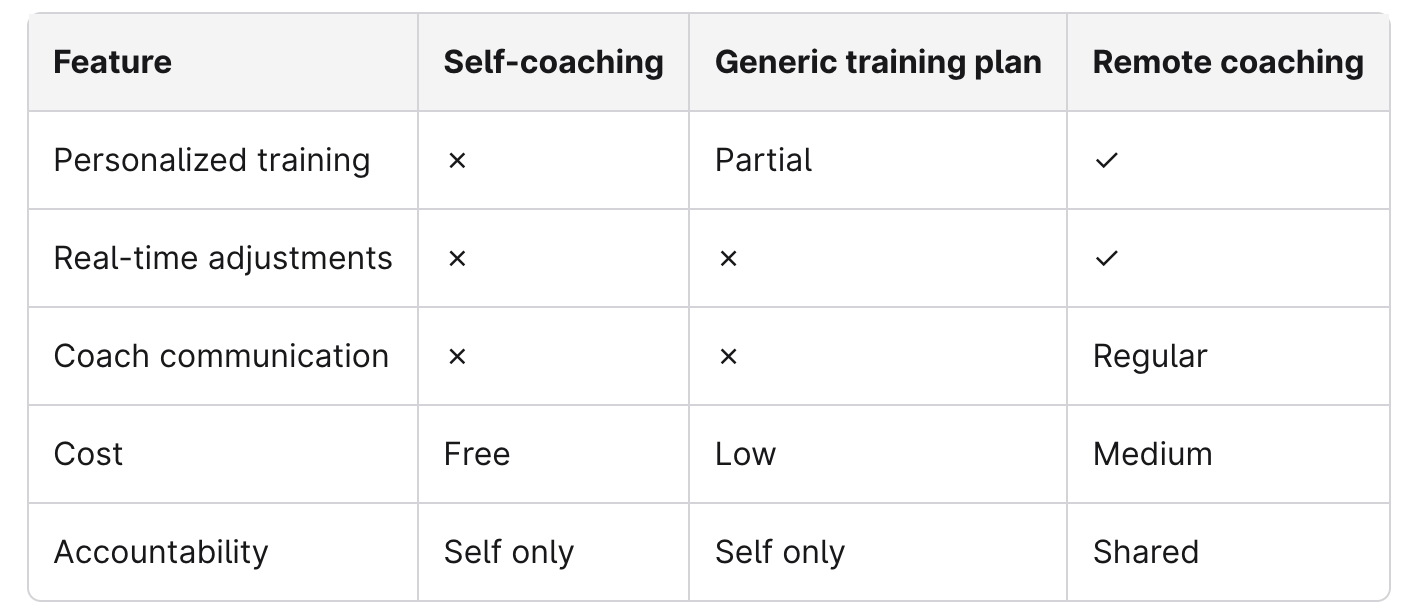
Remote coaching is different because there’s an actual person on the other side. They’re looking at your data, adjusting your plan when life gets in the way, and communicating with you regularly. The fact that they’re not standing on the pool deck doesn’t change that.
Here’s a simple way to see how the three compare:
In practice, a remote coaching setup usually looks something like this:
- Your coach builds your training inside a platform like TriWorldHub, where you can see your sessions day by day.
- You train, you log how it felt, and they check in on your training data (heart rate, pace, power output, whatever your setup captures).
- If something needs to change, they change it.
- If you have a question, you message them.
Some coaches do regular video calls. Others work mostly through written communication and occasional video analysis of your swim or run form.
It’s not self-training, and it’s not impersonal either. It sits somewhere in between — more human than any bespoke plan, more flexible than a fixed weekly session with someone across town.
The Core Benefits of Online Triathlon Coaching
Online coaching has multiple benefits, and here are some that I’ve noticed:
Access to Better Coaches, Regardless of Where You Live
This one is probably the biggest thing.
The best triathlon coaches tend to cluster around certain cities, certain training groups, and certain programs. If you happen to live near one — great. But most people don’t, and that used to mean you either settled for whoever was available locally or you went without.
Remote coaching changes that because you can work with a coach based in Colorado while you’re training in rural Finland. You can also find someone who specializes in exactly your race distance, your age group, and your specific weaknesses, not just whoever happens to be within driving distance.
This matters more than it might seem at first. Coaching quality has a compounding effect over time. A better coach in year one means better habits, fewer injuries, and smarter training in years two and three. The gap between a good coach and an average one grows the longer you’re in the sport.
Flexibility That Fits Real Life
Triathlon training doesn’t happen in a vacuum. It happens alongside jobs, families, travel, bad weeks, and all the other things that make up an actual life.
One of the quiet advantages of remote coaching for me is that it’s built around asynchronous communication. You don’t have to show up at a specific place at a specific time to connect with your coach.
You finish a session, leave a note about how it felt, and your coach reviews it when they’re working. If your Thursday running training needs to move to Saturday because of a work deadline, that conversation happens over a message, not a missed appointment. That’s the flexibility everyone working full-time and training needs.
Research published in the International Journal of Sports Science & Coaching has found that flexibility in training scheduling is one of the stronger predictors of long-term athlete adherence. In plain terms, athletes who can fit training around their lives actually stick with it longer. That consistency, over months and years, is where real improvement comes from.
For shift workers, parents, frequent travelers, or anyone whose week rarely looks the same twice. It’s what makes structured training possible at all.
Data-Driven Approach
This is the part that surprises a lot of beginners. There’s a common assumption that a coach watching you in person has more information than one looking at your data remotely. In many cases, the opposite is true.
Think about what a modern GPS watch or power meter captures: your pace at every moment of a run, your heart rate through an entire bike session, how your power output drifts over the final 20 minutes of a long ride. A coach reviewing that data after your session often sees things that no one standing at the side of the road would catch.
There’s a well-established framework in endurance coaching — developed in large part through the work of Dr. Andrew Coggan on power-based training — that gives coaches a detailed picture of where you are and where you’re heading. It involves metrics like these:
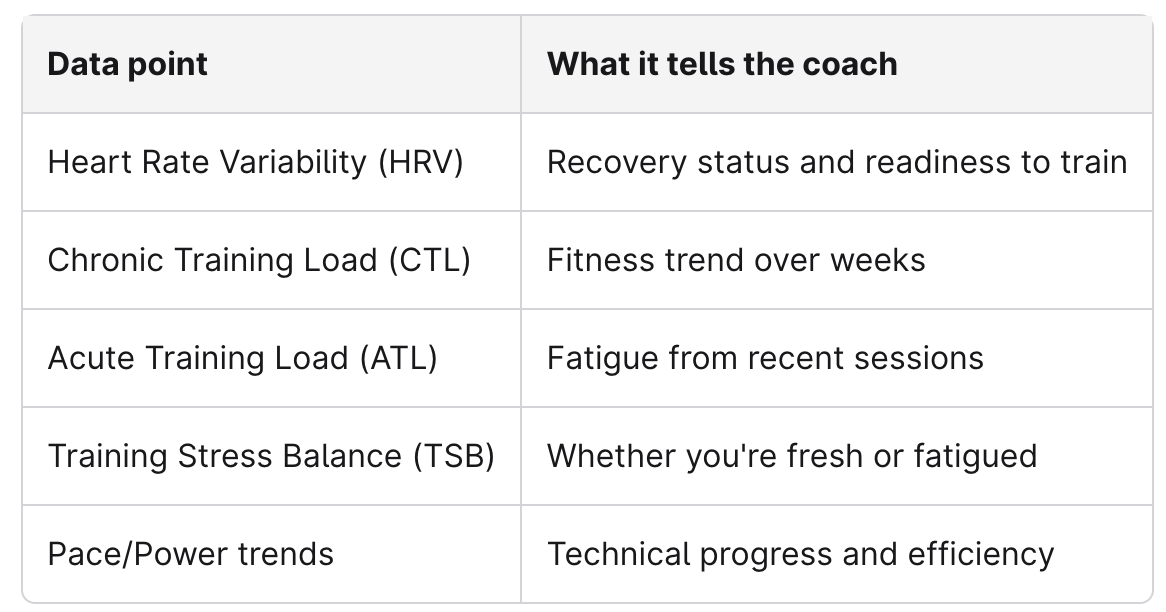
When a coach understands all of these together, they can adjust your plan accordingly — pulling back before you dig yourself into a hole, or pushing forward when the data shows you’re ready for more.
Cost-Effectiveness
Let’s be straightforward about this one, because the money aspect matters for most of us (both elite triathletes and beginners).
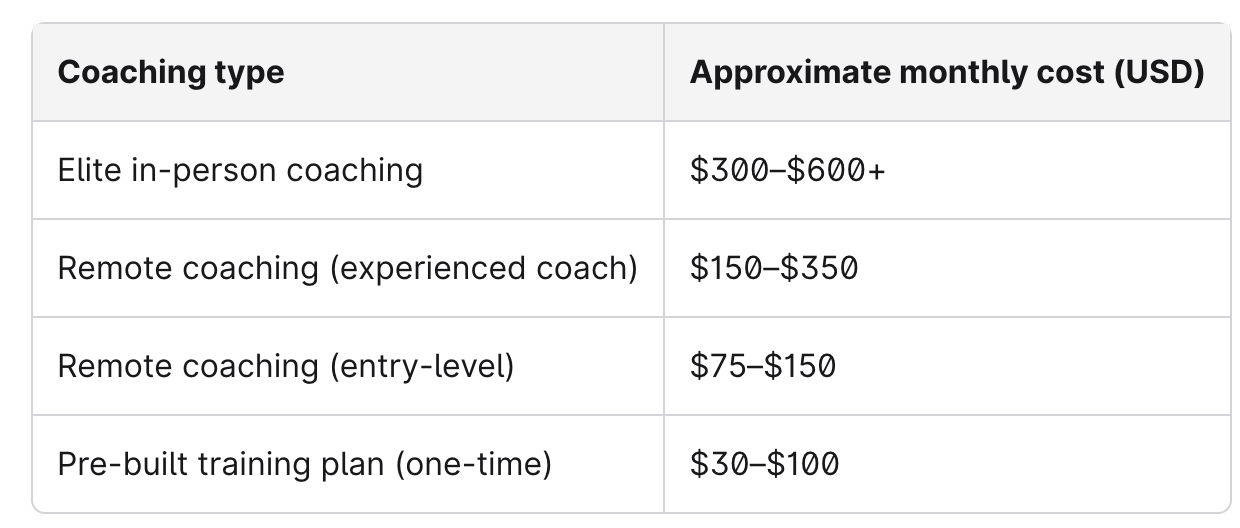
Elite in-person coaching is expensive. For age-group athletes who are funding their own racing, equipment, race entries, and travel, adding a high coaching bill on top of that isn’t always realistic.
Remote coaching tends to cost meaningfully less, while still offering genuine personalization and communication. Here’s a rough picture of what the market looks like:
One honest note: cost alone isn’t a good reason to choose remote coaching. A cheap remote coach who communicates poorly and sends you the same plan every month is just a waste, not a bargain. But for athletes who want real coaching and are working within a real budget, remote coaching makes quality guidance accessible in a way that in-person coaching often doesn’t.
What Remote Coaching Doesn’t Replace
I want to be honest with you here, because I think this is where a lot of articles about remote coaching fall short. They’re so focused on selling the idea that they skip over the parts that actually matter for making a good decision.
Online triathlon coaching is genuinely valuable. But it has real limits, and you deserve to know what they are:
Real-time technical feedback is harder
Even if there are regular check-ins, an online coach might not notice every single flaw in your workouts.
If your swim stroke has a fundamental flaw, a coach on the pool deck will spot it in about thirty seconds. Remotely, that same issue might take weeks to identify, or it might not get caught at all, depending on whether you’re sending video and how good your coach is at analyzing it.
Video analysis tools have improved a lot, and a skilled coach can do a lot with good footage. But it’s not the same as someone standing there, watching you move, and correcting you in the moment. The same goes for run mechanics and bike fit. These are areas where in-person eyes still have a real advantage.
Some athletes need in-person energy for motivation
This is worth being honest about with yourself. If you’re the kind of person who trains better when someone is physically present (when there’s a voice in the room pushing you through the hard intervals, or a training partner next to you on the track), remote coaching may not fully replace that.
It can provide structure and accountability, but it can’t replicate the energy of a shared physical space. Some athletes thrive with remote coaching. Others find they need more direct human presence to stay motivated.
The quality of remote coaching varies enormously
This might be the most important point in this whole section.
Remote coaching has a low barrier to entry, which means there are excellent coaches working this way — and there are also people charging monthly fees while doing very little.
When you’re evaluating triathlon coaches, you need to look past the tools they use and assess the actual quality of their communication, their experience, and their track record with athletes like you.
None of this means remote coaching isn’t worth it. For most self-motivated athletes with clear goals, it absolutely is. But going in with clear eyes makes the whole thing work better.
Is Online Triathlon Coaching Right for You?
So here’s the honest answer, after everything we’ve covered.
Remote coaching works well for athletes who are self-motivated, communicate clearly, and show up consistently, even when nobody is watching. It’s not the right fit for everyone. But for a large number of triathletes, it’s the most realistic path to structured, personalized training that actually helps to achieve success and improve performance over time.
Before you make a decision, ask yourself two simple questions:
Do I have a clear goal I’m working toward?
Not just “get faster” or “finish a race someday” — but a specific event, a distance (like a half-Ironman or a full Ironman distance race), a timeline. Remote coaching works best when there’s something concrete to build toward.
Am I willing to give honest feedback to a coach I don’t see in person?
The whole relationship depends on communication. If your session went badly, your coach needs to know. If something hurts, they need to know. And if life is falling apart and training needs to take a back seat for two weeks, they need to know that too. A remote coach can only work with what you give them.
If you answered yes to both, online coaching is very likely a good fit for where you are right now.
It won’t replace every benefit of in-person professional coaching, of course. But for most age-group triathletes training in the real world (those with real schedules, real budgets, and real lives), it’s one of the more honest and effective options available. And that, in the end, is worth quite a lot.