

After you cross the finish line of the last race of the season, a rush of accomplishment washes over you. The months of following a triathlon training plan have paid off, but within days, something unexpected happens. The relief feels good, but there’s also an emptiness. Your calendar suddenly looks bare. You wonder: what now?
This moment, the space between racing seasons, confuses many endurance athletes. Some treat it like an extended vacation. Others panic and keep training at race pace because they are afraid of losing fitness. But I must say that neither approach serves you well. And what many beginners, especially those who haven’t worked with triathlon coaches yet, miss is that the off-season is actually when real growth happens.
During these weeks away from structured racing, you have a chance to build the aerobic foundation that prevents both burnout and injury when training intensifies again. Use this time wisely, and you’ll start your next season stronger than you finished the last one. This guide will show you how.
What Is Off-Season Training? (And When Should It Start?)
The off-season doesn’t begin the day after your race. There must be some post-race recovery time. Your body needs time to tell you when it’s ready, and that timeline varies based on how far you raced and how hard you pushed. A sprint triathlon might require two weeks of minimal activity. An Ironman-distance race could need a month or more.
Think of the off-season in three distinct phases, each serving a specific purpose. Immediately after your race, consider taking two to three weeks off to boost physical and mental recovery. Sleep in. Take walks and move gently, but don’t structure it. Your body is repairing damage you can’t see, and your mind is processing the intensity of race preparation.
After that initial rest, you enter a transition phase that usually lasts two to three weeks. This is when you return to activity, but without the pressure of training plans or chasing performance goals.
You can swim if you feel like it. Go for an easy bike ride with friends, or try a yoga class. The goal is reconnecting with movement as something enjoyable rather than obligatory. Your body is rebuilding resilience during this time, even though the workouts feel almost too easy.
Finally, you move into base building, which typically lasts four to six weeks. Here, you return to consistent training across all three sports, but the intensity stays low. You’re increasing aerobic capacity, which is the foundation that everything else rests on. This phase prepares you for the structured training that comes when you start preparing for specific races again.
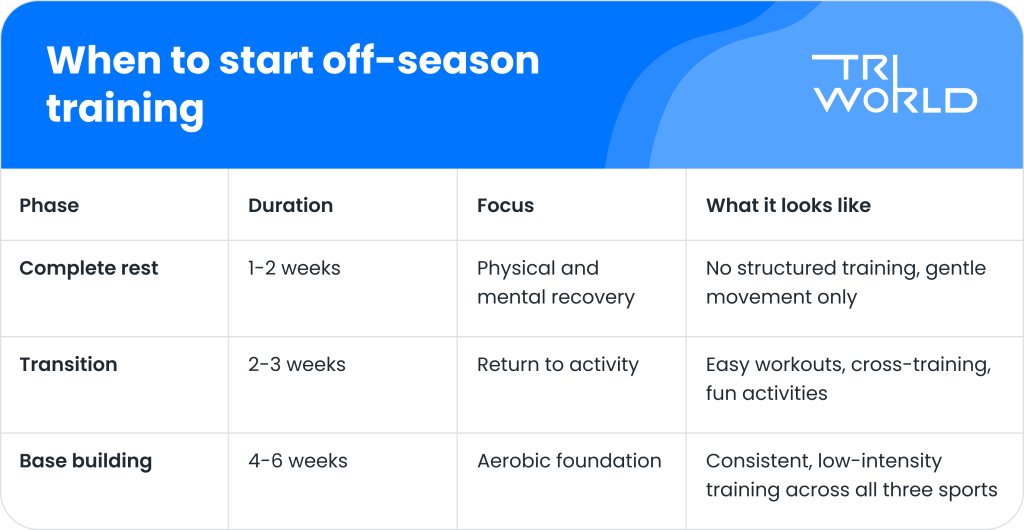
The entire off-season usually spans six to ten weeks, but your personal timeline might differ. If you’re still feeling mentally exhausted or physically depleted, extend the early phases. And if you’re restless and genuinely excited to train again, you can gradually shift toward base building.
The Core Benefits of Off-Season Training
The off-season shouldn’t be used to just try to maintain fitness. Honestly, if that’s all you’re thinking about, you’re missing something important. This period works quietly in the background and helps us build foundations that we won’t fully appreciate until later.
Letting your body actually heal
Think about it: after months of pushing hard, your body doesn’t get a chance to truly recover between workouts or even between weeks. Your connective tissues, hormones, and immune system need real downtime to get back to where they should be.
Studies have shown that athletes who give themselves proper quality time recovery get injured less and actually perform better over time than those who just keep grinding. The off-season finally gives your body the breathing room it needs to finish all those repairs that kept getting interrupted when you were preparing for races.
Actually fixing the small things
The off-season is really the best time to evaluate past performances and set new goals for the new season. Because, when you’re deep in race prep, you’re usually too tired to think about the details, like how your swimming stroke could be smoother or whether your running form needs work. But now, with less stress on your system, you have the energy and focus to work on those mechanics.
For example, you can work on how you breathe while swimming, or adjust how your foot hits the ground, which takes real concentration and practice. These weeks give you the space to make those adjustments so they feel natural when things get intense again.
Building real strength
Your body can only recover from so much at once. If you’re already doing hard swim, bike, run sessions all week, throwing in serious strength work just piles on more fatigue.
But during the off-season, it is a primary window for heavy lifting, which would cause too much fatigue during race season. You have enough time to build the resilience that keeps you healthy later: stronger hips for running, more stable shoulders for swimming, and more powerful legs for cycling.
Research on endurance athletes keeps showing that the ones who do dedicated strength work during these lighter periods end up more durable and powerful.
Having room to try new things
Ever wanted to test out a new training approach you heard about? For example, a Norwegian method of periodization? Curious about different gear? Thinking about working with a coach?
This is your window to explore without worrying about a race around the corner. You can try things out to see how your body responds and make changes, if needed.
Some of what you try will stick and become part of how you train. Some won’t work, and that’s okay. You’ll learn something either way. The off-season gives you permission to be curious instead of single-minded.
Now that we’ve explored the benefits and opportunities of off-season training, let’s move on to actual examples of how you can get better at each of the triathlon disciplines.
Swimming in the Off-Season: Technique Over Volume
Cutting your weekly swim volume by 30-40% in the off-season might feel strange at first, but it’s one of the smartest moves you can make. When I first did this, I was surprised by how much easier my swim felt once the season started again. After a few weeks, I’ve noticed that my stroke has become smoother and more efficient.
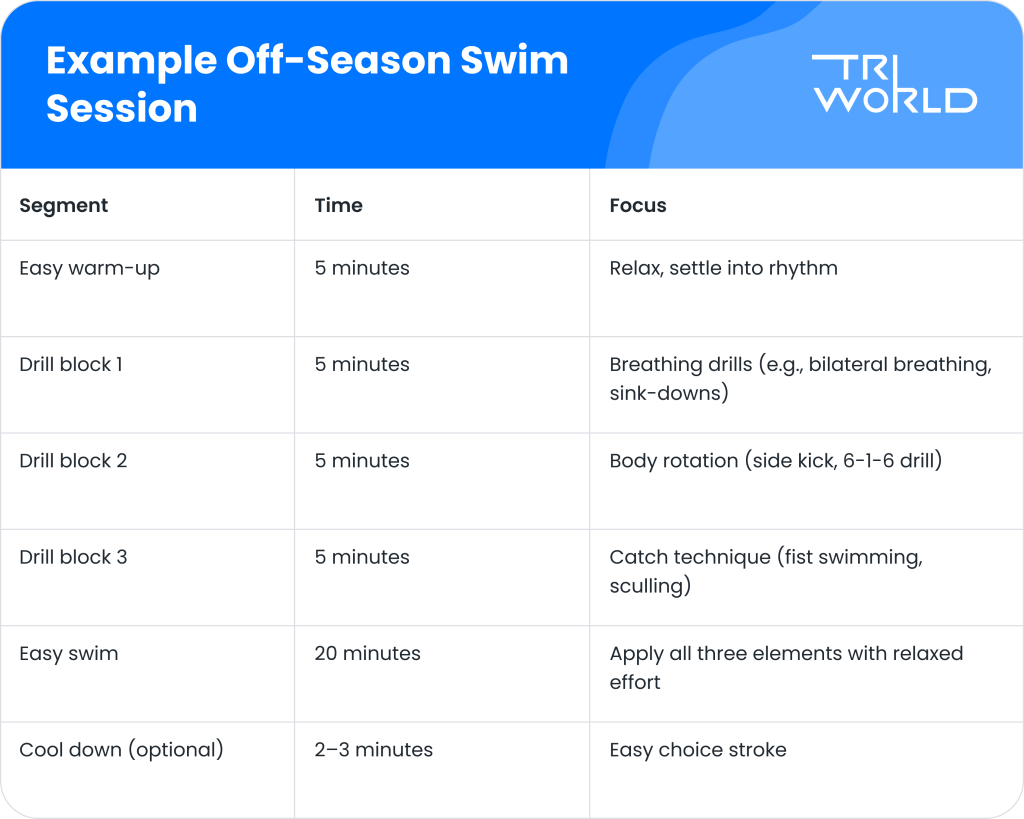
Most triathletes, especially beginners, have a lot of room to grow in the water. And the off-season is the only time when you’re not rushed by high-volume training sessions and can actually slow down enough to think about how you move. The biggest areas to look at are breathing, body rotation, and the catch at the front of the stroke. These three pieces control how well you move through the water.
Try to work on one element per session. If you can, film yourself or ask a coach to watch your stroke. What feels smooth inside your head often looks completely different on video. This feedback alone can save you months of guessing.
Aim for two to three short swim sessions per week, around 30–45 minutes each. Keep the sessions focused: start with drills, then swim easy while applying what you practiced.
Cycling in the Off-Season
Keep riding, but strip away the pressure. The off-season is when cycling should feel like what it probably felt like when you first fell in love with bikes — pure enjoyment of movement and scenery.
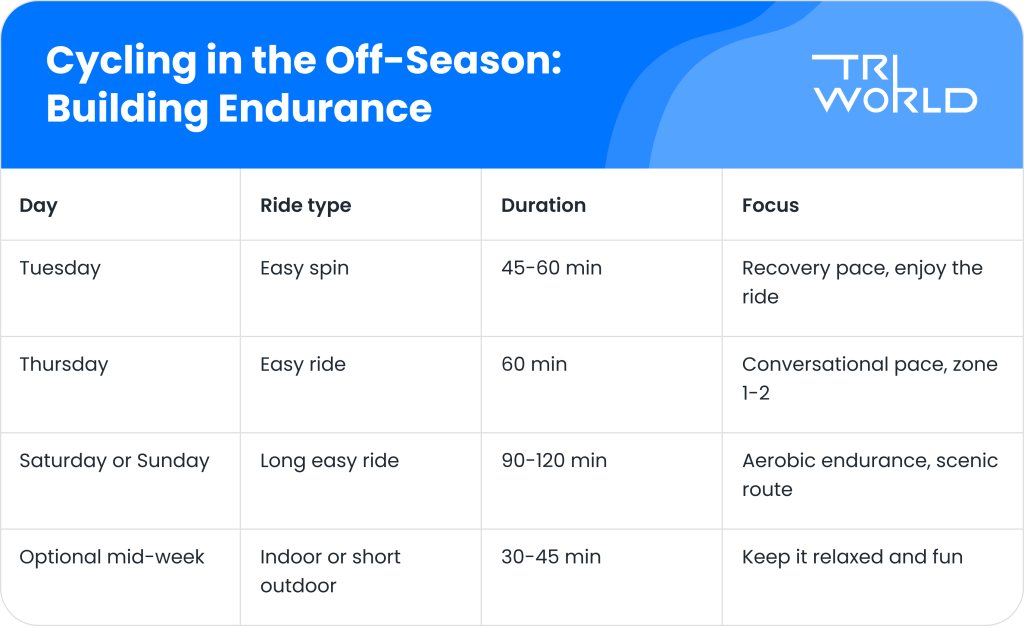
Focus on easy, long rides that build aerobic capacity and don’t leave you feeling exhausted afterward. These rides happen in Zone 1 to Zone 2, at a pace where you can hold a conversation comfortably. If you’re breathing too hard to talk in complete sentences, you’re going too hard for off-season purposes.
This is also the perfect time for scenic routes you’ve been meaning to explore and group rides with friends where the social aspect matters more than the speed. The mental break from structured cycling intervals and power targets is just as valuable as the physical adaptation happening in your muscles.
For bad weather days, indoor training is fine, but keep it fun rather than intense. Watch a show, listen to music, or join a relaxed virtual ride. Save the suffering for race preparation.
Your practical cycling plan should include two to four rides per week. Focus on time in the saddle rather than speed or distance targets. Here’s what a balanced week might look like:
The off-season is also an ideal time for bike maintenance (see this bike maintenance checklist for instructions), equipment upgrades, or even getting a professional bike fit. Small adjustments now prevent bigger problems when training volume increases.
Running in the Off-Season: The Foundation of Your Success
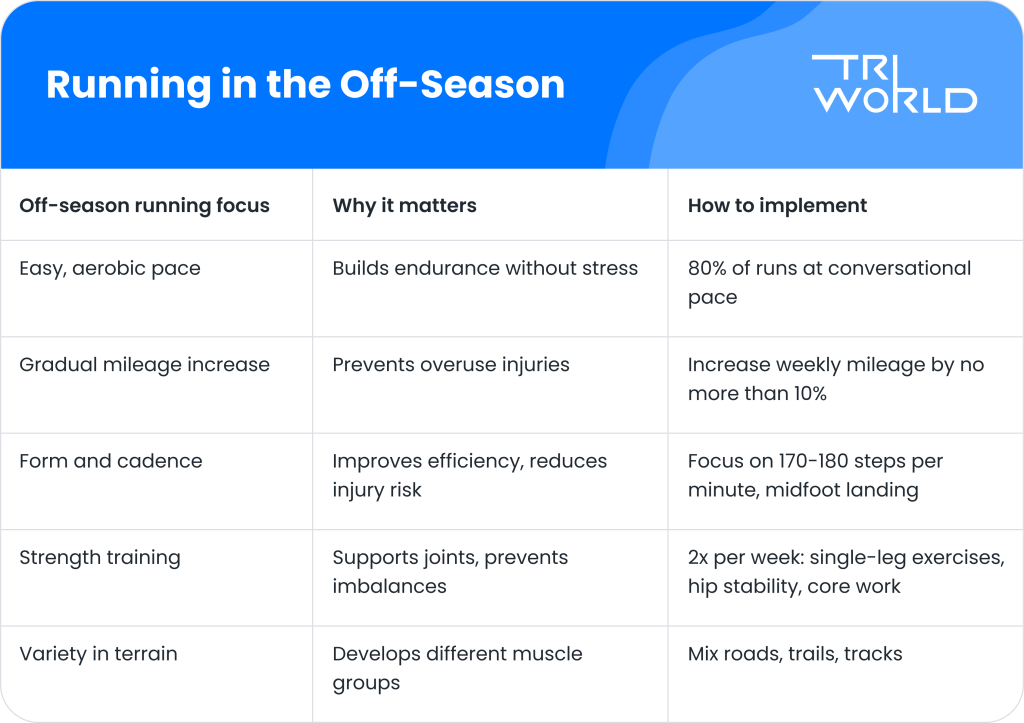
Running deserves special attention during the off-season because it’s where most triathlon injuries happen, and where the off-season can make the biggest difference to your long-term success. I consider it a chance to build the running base that will carry me through the next big races.
Running closes the race. And no matter how well you swim or bike, it is the run that determines your finish time. It’s also the discipline that requires the most recovery because of its higher impact on joints and muscles. Every foot strike sends force through your ankles, knees, hips, and back. Multiply that by thousands of steps per run, and you understand why runners face more overuse injuries than swimmers or cyclists.
That’s why form matters more in running than in the other two sports. Poor swimming technique slows you down. Poor cycling form wastes energy. But poor running technique leads directly to injury. You’ve probably already experienced shin splints, IT band syndrome, plantar fasciitis, or stress fractures.
On top of that, the biomechanics of running are less forgiving than swimming or cycling. And here’s the challenge: running fitness takes time to build. You can’t rush the process of strengthening tendons, ligaments, and bones without consequences. That’s why the off-season is so valuable. You have time to do things right.
You can gradually increase running mileage while your body adapts. Instead of ignoring form because you’re too tired to think about it, you can practice better movement patterns. And instead of skipping strength work because you’re already doing so much, you can build the supporting muscles that keep you and help you race faster. Plus, it is a perfect time to improve breathing technique durign run.
Strength Training: The Secret Weapon
The off-season is ideal for building strength because you finally have the energy and recovery capacity to do it properly. During race preparation, your body is managing high volumes of swimming, cycling, and running. Adding serious strength work on top of that often leads to overtraining rather than gains. But now, with lower cardiovascular stress, your muscles can actually adapt to resistance training and become stronger.
Strength training prevents injury and improves power across all three disciplines.
A strong core maintains better posture during long bike rides and runs. It reduces back pain and improves your efficiency. Single-leg exercises build stability that protects your knees and ankles during running. You can implement these stretches for runner’s knee prevention.
Additionally, doing hip strength exercises prevents the compensations that lead to IT band issues and lower back problems. Upper body work, often neglected by triathletes, improves your swimming pull and helps you control your bike more effectively, especially in wind or rough conditions.
During strength work, your focus should be on functional movements that translate directly to triathlon performance. Two to three sessions per week, each lasting thirty to forty-five minutes, is a good plan.

How to Create Offseason Triathlon Training Schedule
Structure is helpful, but the key to a successful off-season is flexibility. The schedule isn’t meant to be a rigid plan you have to stick to, but a framework to keep you active and moving regularly without all the pressure of hitting specific performance targets.
You’re not tied to your schedule. If you wake up one morning and don’t feel like doing a workout, just reschedule for another day. And if the weather is perfect for a long ride on what was supposed to be a recovery day, go ahead and take advantage of it. That’s the kind of adaptability that makes the off-season so restorative.
A well-balanced week of training will include a mix of all three sports, strength training, and proper rest. You should be aiming for 6-8 hours of total training time. Take a look at this sample week, notice how it prioritizes recovery and keeps the intensity low throughout:
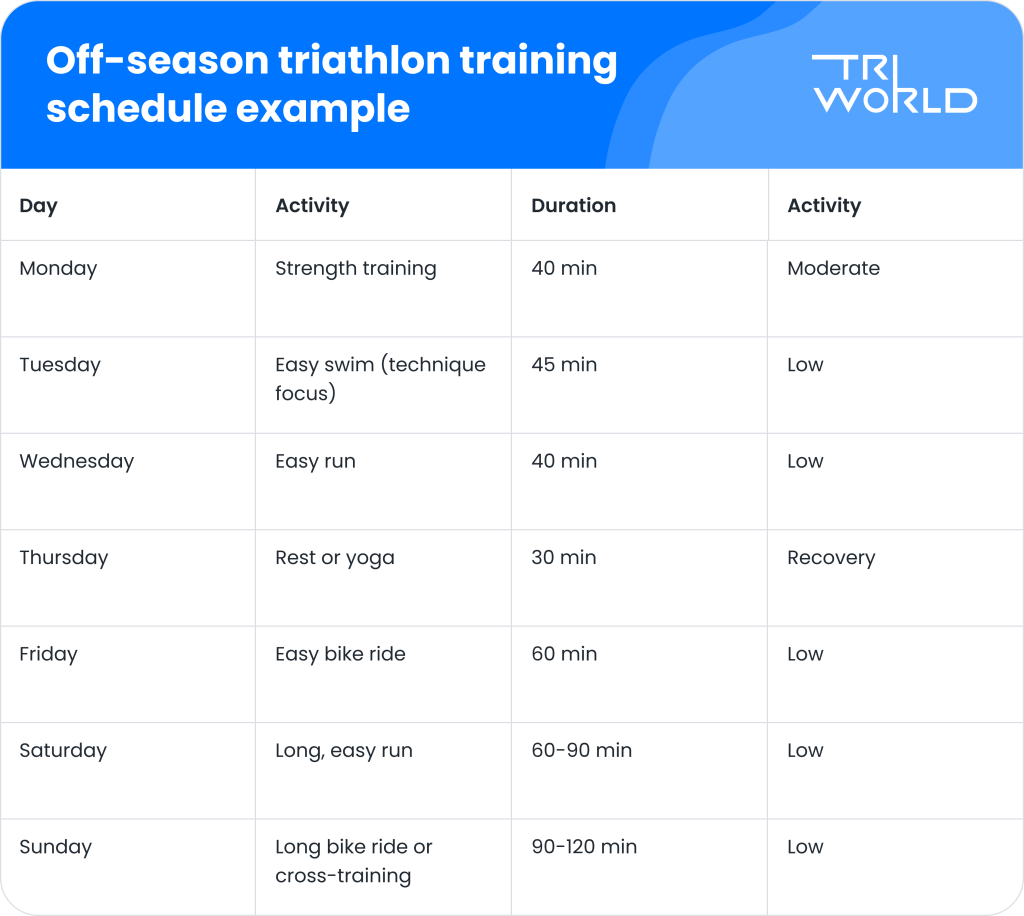
Remember, this is just a template. Your week will likely look different based on your own schedule, access to trainers and facilities, and personal preferences. Maybe you prefer swimming on weekends when the pool is less crowded, or you need two full rest days instead of one. That’s perfectly fine.
Common Off-Season Mistakes to Avoid
Mistakes during the off-season set you up for problems that come up months later. And often it happens when you’re deep into race preparation and can’t afford setbacks. Check out these pitfalls to navigate the off-season more effectively.
Taking way too much time completely off
A typical off-season lasts 12–16 weeks following an initial recovery period. Keep in mind that initial recovery should last 2–4 weeks and focus on light activity to reduce mental and physical inflammation.
A little break is healthy, but many athletes stretch that just one more week into a few months. I’ve done it myself, and the comeback always feels heavier than expected.
The thing is, your aerobic fitness starts slipping quickly: studies show it can drop noticeably within only two to three weeks of doing nothing. That’s why it feels like such a shock when you finally start again. You don’t need hard training right now, but you do need a bit of consistency to avoid rebuilding from scratch.
Rushing into hard sessions because you feel rested
Mentally, you’re sharp and ready. Physically, your connective tissues are still a step behind. In fact, tendons and ligaments adapt much more slowly than your heart and lungs, which is why early-season injuries often hit athletes who feel great and suddenly jump into intervals or hard group rides. Your mind says yes, but your body needs a gentler ramp.
Ignoring small injuries that were nagging you at the end of the season
That stiff Achilles you noticed during your last race? The shoulder that buzzes during hard swim sessions? They won’t disappear on their own. Many endurance athletes admit they push through pain during the season simply because there’s no time to deal with it. Off-season is that time, and studies show that addressing issues early prevents the chronic problems that derail training later. A few weeks of rehab now is a lot cheaper than losing a month in April.
Letting nutrition go completely and
Your nutritional needs for training should be adjusted to match reduced training volume during the off-season. So, if you train less, you should eat less, but still keep all the nutrients in place. For example, you should maintain protein intake at 1.4–2.0g/kg/day. This will help you support muscle repair from strength training efforts during the off-season.
Of course, a little weight gain is normal. But a lot can make everything harder. There’s a simple reason: extra pounds dramatically increase the stress on your joints, especially when you run, where every step multiplies that load.
Research on running biomechanics shows this clearly, which is why gaining ten or fifteen pounds over winter can make those first sessions back feel like running through mud with a heavy backpack. You don’t need a strict diet. You just need some balance.
Disconnecting from the sport and people who keep you motivated
The off-season is supposed to feel lighter, but shutting everything off — no training partners, no easy group sessions, no races on the horizon — can make it surprisingly hard to restart.
There’s plenty of research showing that athletes with strong social support stay more consistent and happier with their training. Even a casual Sunday ride with friends or signing up for a race months away keeps you mentally anchored to the sport without pressure. Also, you can join triathlon community platforms, like TriWorldHub, where you can meet and communicate with other athletes and coaches. It’s completely free to try, so sign up to check it.
When to Start Building Back Toward Race Season
There comes a natural moment when the off-season flags are waving, and it’s time to shift gears into base training, which ultimately sets you up for those killer race days. The signs you’re ready to leave the off-season in the dust are a mix of physical and mental. Here’s what to look out for:
- A restful feeling that’s more than just a break from being exhausted. You’re genuinely feeling refreshed.
- You find yourself actually looking forward to getting back into structured training. No more dreading the daily workouts.
- No lingering niggles or achey bits – you’re injury-free.
- During easy workouts, your body is humming along, responding as it should.
Now, just like everything else in triathlon training, the move from off-season to base training needs to be a gentle one. You’re increasing volume before you bring in the intensity. Don’t be afraid to start with some small increments. Add 15 to 20 minutes to your longer sessions each week, or maybe even introduce an extra swim or run. Some people do it by adding a fourth workout to their week.
It’s still relatively easy going, but you’re doing more of it on a regular basis. This base-building phase usually lasts around 8 to 12 weeks, and that’s what lays the groundwork for the harder training that’s to come. Just remember to be patient and let the process happen. You’ll probably feel like you can just dive back into intense stuff the minute you feel ready, but it’s so much smarter to let your body catch up. I’ve seen it time and time again. The athletes who take it one step at a time and trust that their body will get there in the end are still knocking out PRs years down the line. On the other hand, those who rush right back in without giving it the time and respect it deserves are the ones who end up sidelined with injury and frustration.
Conclusion
The triathlon off-season is a chance to catch your breath, though to be honest, it’s about the last thing you feel like doing when it starts. We’ve all been through the grinder with triathlon training. The constant discipline required, the physical and mental testing of racing, and the sheer organisational challenge of juggling three sports in one is a massive ask.
So, no surprise you’re feeling a little like you deserve a break. Well, you do. You’ve earned some time to step back and remember why on earth you’re putting yourself through all this.
Make the most of these weeks, and come next season you’ll be in a better place, stronger, healthier, and more fired up than you were at the end of the last one. Trust that even when things are easy, it’s still work that matters, and that laying down a solid foundation is way more important than trying to maintain peak form all year round. And when those dreaded race days roll around again, you’ll know the difference your downtime has made, and be ready because you’ve given yourself permission to take a break and start again.