

If you’re just getting into triathlon or any other endurance sport, having a good watch really makes a difference. It helps you see what’s actually happening in your training instead of guessing or using a basic watch that can’t track much. It’s simply easier to improve when you can measure things properly.
A triathlon watch is better than using a regular smartwatch for triathlon training because it’s specially designed for sports like swimming, cycling, and running. Triathlon watches are tougher, more accurate, and have specific features that help with training and racing.
For example, a regular smartwatch might not be as durable and might not track your swimming accurately because it’s not made to handle water well. But a tri watch is water-resistant and can accurately track your swim strokes, distance, and speed.
In this article, we’ll cover everything you need to know when choosing the best triathlon watch. First, we’ll talk about the features you should consider. Then, we’ll show you some of the best triathlon watches to check out. Finally, we’ll give you tips on choosing the right training watch for the triathlon.
Why You Need a Dedicated Triathlon Watch
Training for a triathlon means juggling three disciplines, each with its own demands and metrics. While your smartphone might track your morning run, it’s not going to survive an open-water swim or help you nail those brick workouts. That’s where a dedicated triathlon GPS watch comes in.
Triathlon watch vs regular smartwatch
Regular smartwatches excel at notifications, contactless payments, and tracking your daily steps. They’re brilliant for general fitness, but they’re not built for the specific demands of triathlon training.
A dedicated triathlon watch is designed to handle multiple sports in a single session, withstand hours in chlorinated pools and saltwater, and all that while providing the precise data you need to improve across all three disciplines.
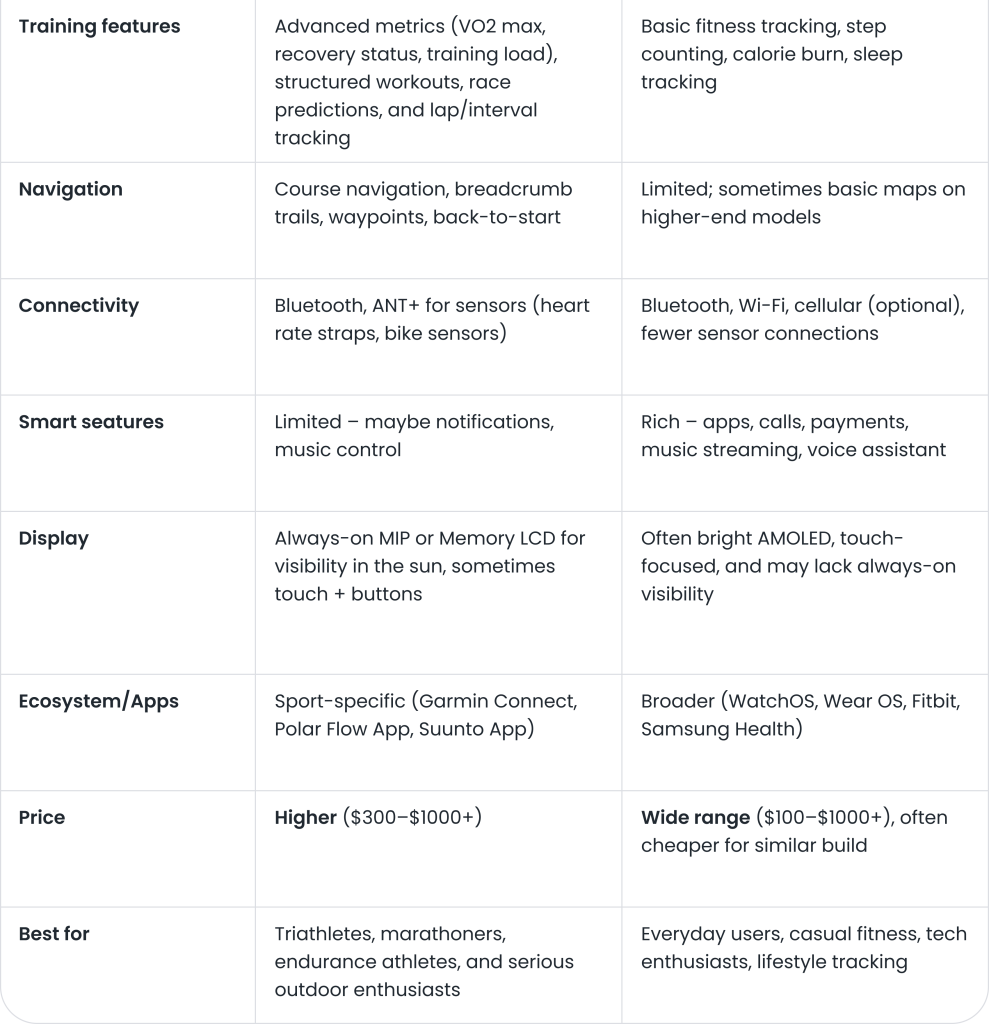
Let’s see how triathlon watches compare to regular fitness watches:

What’s the Best Tri Watch for Multisport Athletes?
As we’ve mentioned, watches for triathlon are created to fit the needs of those participating in multisport events.
These watches offer several features tailored to the demands of each segment of the race. Let’s explore the core features of a triathlon GPS watch to look for.
Water resistance
Water resistance is fundamental. But there’s water resistance, and then there’s I’m swimming 3.8 kilometres in the ocean resistance. Kinda different things.
Look for watches rated to at least 5 ATM (50 metres), though most proper triathlon watches exceed this significantly.
Another thing to keep in mind is that open-water swimming presents unique challenges that pool swimming doesn’t. GPS signal acquisition while your arm is underwater, wave interference, and the need to sight while maintaining pace all require specific features.
The best triathlon watches use algorithms that account for the circular motion of your stroke, filtering out erratic GPS readings caused by choppy water.
Pool swimming metrics are equally important for training. Automatic lap counting, stroke type recognition, and SWOLF scores help you track improvement over time. Advanced models even detect when you’ve pushed off the wall versus when you’re actually swimming, giving you accurate active swimming time rather than just session duration.
Multisport tracking
This is the defining feature of a triathlon watch. Multisport mode allows you to switch between swim, bike, and run with a single button press. The best thing is that it allows you to maintain one continuous activity file that captures your entire session or race. It’s both convenient and essential for tracking transition times and performance analysis.
The best implementations are seamless. You finish your swim, tap a button as you head to T1, tap again when you start cycling, and so on. The watch automatically pauses GPS during transitions so your data remains clean. Some advanced models can even auto-detect activity changes, though most athletes prefer the reliability of manual switching.
For training, multisport mode enables brick workouts, those crucial bike-to-run sessions that prepare your legs for the specific fatigue of racing. You can analyze how your run pace is affected by different bike intensities, helping you dial in your race-day strategy.
Accurate GPS tracking
GPS accuracy determines whether your training data is useful or misleading. Poor GPS accuracy can show you ran 10.5 kilometres when you actually ran 10K. It can throw off your pacing calculations and training load metrics. For triathlon, where you’re often in challenging environments, such as urban canyons, dense forests, or open water, multi-band GPS (which uses multiple satellite systems simultaneously) provides significantly better accuracy.
Route navigation becomes crucial for long training rides and races in unfamiliar locations. Breadcrumb navigation shows your planned route on a simple map display, alerting you when you’ve strayed off course. More advanced models include turn-by-turn directions and even preloaded maps, though this level of detail often comes with trade-offs in everyday battery life and price.
For triathletes who like exploring new routes, the ability to download courses from platforms like Strava or Komoot directly to your watch is invaluable. You can focus on your effort rather than constantly checking road signs or your phone. In races, having the course loaded means you know what’s coming, whether it’s a steep climb or a technical descent, and you can adjust your pacing accordingly.
Heart rate monitoring
Wrist-based optical heart rate measurements have improved dramatically, but they’re not perfect. During high-intensity intervals, for example, cycling interval training or cold-weather swimming, accuracy can suffer. The best triathlon watches support external heart rate straps via ANT+ or Bluetooth and give you the option to use a chest strap when precision matters most.
Training zones are where heart rate data becomes actionable. Your watch should allow you to set custom zones based on your lactate threshold or maximum heart rate, then provide alerts when you drift outside your target zone during workouts. Over time, tracking heart rate variability (HRV) and resting heart rate helps you monitor recovery and avoid overtraining. These aspects are critical for athletes balancing three disciplines and the core of the Norwegian method of training periodization.
Advanced models like Garmin’s Fenix range incorporate features like training load, recovery time estimates, and race predictions based on your current fitness. While these metrics shouldn’t replace common sense or professional coaching, they provide valuable context.
If your watch is telling you that you need 48 hours of recovery but you’ve got a key workout scheduled, you can make an informed decision about whether to proceed, modify, or rest.
Great battery life
Battery life specifications can be misleading. Manufacturers often cite maximum battery life in watch mode (minimal features active) rather than full GPS tracking and heart rate monitoring mode. For a triathlon, you need to know how long the watch will last with everything running: GPS, heart rate, and potentially music or navigation.
An Ironman-distance race can take anywhere from 9 to 17 hours, depending on your fitness and the course. Your watch needs to last the entire time, plus some margin for pre-race setup and post-race cooldown. Most entry-level models offer 12-20 hours in full GPS mode, which is adequate for most triathletes. Serious long-distance athletes should consider models offering 30+ hours, or those with battery-saving modes that reduce GPS polling frequency.
Your training volume matters too. If you’re consistently doing 15-20-hour training weeks, you don’t want to charge your watch every other day. Look for models that balance battery life with the features you actually use. Some watches allow you to toggle features on and off, like disabling music and maps when you don’t need them, and you’ll extend battery life significantly.
Customizable data screens
The ability to customize what you see during training and racing is more important than it might seem. Different workouts require different data. During tempo runs, you might want current pace, average pace, and heart rate displayed prominently. On recovery days, you might prefer just time and distance to avoid obsessing over pace.
Most triathlon watches allow you to create multiple data screens per sport, each displaying 2-6 data fields. You can cycle through these screens with a button press or a swipe, adapting to changing conditions or workout phases. The best implementations let you set up entirely different profiles: one for racing, one for easy training, one for intervals, that you can switch between quickly.
Integration with third-party services
Triathlon watches often integrate with third-party services like Strava, Training Peaks, and other sports tracker apps. Just recently, we’ve added synchronization with Garmin to TriWorldHub, so you can track your training within our platform, collaborate with a triathlon coach, and adjust your training load to your goals and current fitness.
Most modern triathlon watches sync via smartphone apps, uploading activities automatically when in range.
Summing up, triathlon watches are crucial tools for dedicated triathletes. They offer durability and provide performance stats tailored for multisport training. Now that we’ve explored all the essential fitness features, let’s see what the best watches for triathletes are.
Best Triathlon Watches to Track Your Swims, Cycles, and Runs
Accuracy and versatility are key when it comes to triathlon watches. These devices go beyond tracking your runs.
We’ve explored multiple reviews and, based on the data we’ve found, gathered a list of the best triathlon watches for your 2026 races.
To select the best watches, we considered the following factors:
- Seamless monitoring of biking, swimming, and running activities.
- Precise distance and route tracking, supported by strong GPS and reliable offline mapping.
- Resistant to water to withstand swimming and adverse weather conditions.
- The quick transition between different sports without interrupting tracking or timing.
- High heart rate accuracy for better pacing, recovery, and performance insights.
- Extended battery life to support long-distance events or training sessions.
- Detailed analysis of performance metrics like pace, cadence, and stroke count.
- Integration with accessories like chest straps for enhanced heart rate monitoring or cycling sensors for more precise data.
- Ability to customize data screens, alerts, and training plans to suit individual needs and preferences.
- Seamless syncing with smartphones or computers for data analysis and sharing with training apps or platforms.
- A simple and intuitive user interface, with customizable screens, alerts, and training plans.
When evaluating these features, we’ve selected the top 8 triathlon watches that best meet all the serious triathletes’ needs. You will find watches with different capabilities and price ranges, so this list has something for every budget and need.
What is the Best Smart Watch for Triathlon in 2026?
Here are our top picks of the best watches for triathlon to check out. Expect to see a few Garmin and Suunto triathlon watches in this list. It’s because these companies invest a lot in innovation and craft top-notch multisport watches.
Check out our top picks of best watches for triathlon. Warning: Expect to see a few Garmin and Suunto watches in this list. Its because these companies invest a lot in innovation and craft top-notch multisport watches.
Garmin Forerunner 965 or 970 Specs
According to multiple reviews on Amazon and other platforms, Garmin Forerunner 965 is the top choice for many thriatheletes. And in 2025, they’ve released Garmin Forerunner 970 Specs, which is more durable (with a sapphire crystal lens and titanium bezel), adds ECG & skin-temperature sensing plus a new Elevate Gen 5 heart-rate sensor, includes a built-in LED flashlight, speaker and microphone for calls/voice control, and brings new running and training metrics (like Running Tolerance, Running Economy, improved multisport support and updated UI), while still keeping the same sharp 1.4″ AMOLED display and full multisport tracking.
In their feedback, users really appreciate the quality of its watch, GPS tracking, and long-lasting battery. Additionally, athletes like its versatility, with some calling it ideal for various activities, while others highlight its dual-band GPS for superior accuracy.
Customers are happy with features such as the heart rate monitor and the watch’s rugged style. However, there are mixed opinions about its value for money and overall performance.
Specifications:
- The Garmin Forerunner 965 is equipped with a 1.4-inch (35.4 mm) touchscreen bright AMOLED display with a resolution of 454×454 pixels, hardened Gorilla Glass DX, and a titanium bezel.
- The overall diameter of the gadget capsule with 5ATM water resistance is 47 mm, and the thickness of the watch does not exceed 13.2 mm.
- The memory capacity is 32 GB.
- Onboard music storage to listen to without a smartphone (via Bluetooth headphones). Direct downloads from Deezer, Spotify, or Amazon Music are supported.
- The battery life in moderate usage mode is up to 23 days, and in GPS workout tracking mode, it is up to 31 hours.
- Weight: It weighs 53 grams.
- Water resistance: The watch is water-resistant, up to 5 ATMs.
- Maps: Built-in maps for navigation.
- Health tracking: Accurate heart rate monitoring.
- Price: from $599
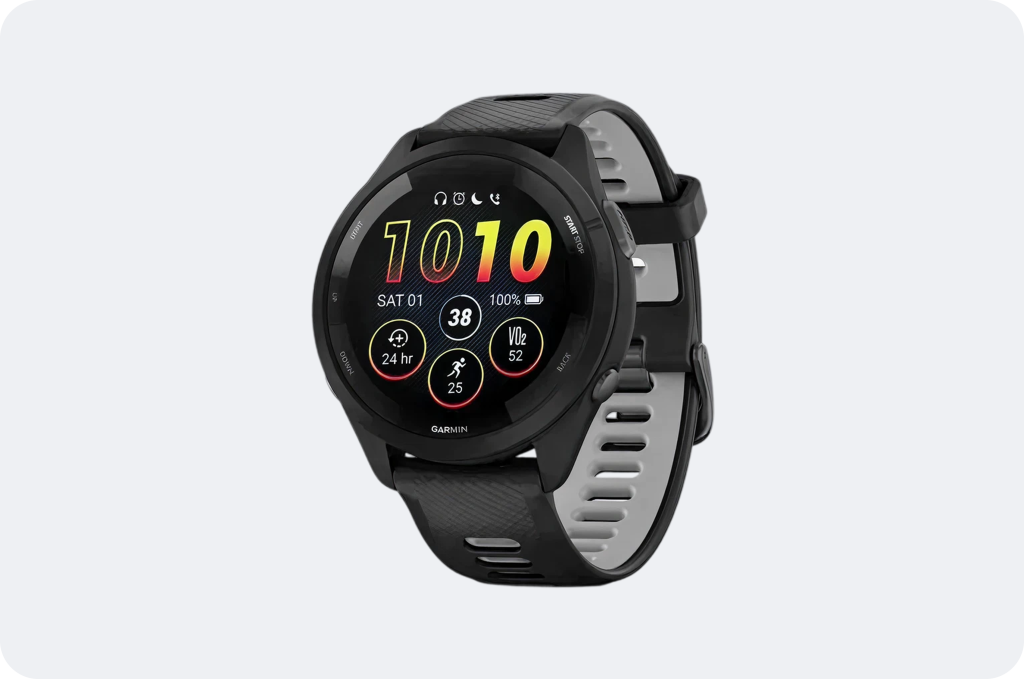
Here are a few more advanced Garmin Forerunner 965 features:
- Routes with step-by-step directions
You can create or find existing routes in the Garmin Connect app or sync from your favorite third-party platforms and receive step-by-step directions.
- Loop route
Specify the distance you want to cover – and get route suggestions that bring you back. Also, use the TrendLine feature to find the best local paths.
- Recovery tracking
Based on your recent workout, find out how much time you need to recover physically before your next intense training session.
- Race prediction
You can estimate your pace for 5 km, 10 km, half-marathon, and marathon distances.
On top of that, you can listen to music directly from the watch and use Garmin Pay for quick, contactless payments. All these features make the full Garmin Forerunner setup even more convenient during training and races.
Sigma iD.TRI
The Sigma Sport iD.TRI sports watch is designed for professional triathlon training as well as individual disciplines such as running, cycling, and swimming. You can also set your own sport mode.
A fundamental difference from the ID.FREE model is the Workouts and Competition modes. Workouts involve pre-planned training sessions with specific target parameters, while Competition mode is for triathlon competitions and preparation for them.
Its simple, intuitive controls, combined with smart functions and special accessories, will please not only newcomers but also experienced triathletes. Thanks to Bluetooth, ANT+, and USB, the iD.TRI can be connected to smartphones, computers, and external sensors.
Moreover, the iD.TRI watch is not only a reliable partner in triathlon but also suitable for daily use due to its activity tracking and sleep quality analysis features.
The well-thought-out training system of the iD.TRI watch measures all values relevant to triathletes in individual disciplines through special algorithms. Sports profiles can be adjusted and viewed separately on the watch. Target zones and workouts can be set based on various parameters, which can be assessed and analyzed using Sigma software tools.
Specifications:
- Dimensions: 30 x 25 x 8 mm
- Data transmission: ANT+/Bluetooth
- Battery life: Up to 14 days
- Water resistance: 50 m (5 ATM)
- Weight: 42 g
- Materials: Plastic, mineral glass, silicone
- 4 user sports profiles
- GPS
- Smart light
- Failure warning
- Training in target zones
- Weather trends
- Personal records
- Bluetooth Smart and ANT+ connection to external sensors
- Activity tracking, including sleep analysis
- Competition mode and planner
- Special algorithms for swimming, cycling, and running
- SnapOn Bike Mount
- Sensors: GPS, heart rate, accelerometer, altimeter, compass
- Price: ~$250-$280

Overall, the iD.TRI watch is designed to help triathletes prepare for and finish competitions stress-free. It has a special racing mode where you can customize the order and distance of disciplines, allowing for different race types like duathlons.
During races, it tracks transition times between disciplines and reminds athletes to refuel and stay hydrated. With a simple menu and four buttons, it’s easy to use. Its slim design makes it suitable for wearing under neoprene clothing during swimming, and it’s water-resistant up to 5 ATM. Plus, it’s made of premium materials and has interchangeable silicone straps.
Thanks to USB and Bluetooth, the iD.TRI watch can connect to PCs and smartphones. For training setup, as well as professional evaluation and data analysis, triathletes have access to the Sigma DATA CENTER and Sigma LINK app.
Polar Grit X2 Pro
Polar Grit X2 Pro is a premium multisport/outdoor smartwatch built for athletes and adventurers who need reliable tracking, navigation and robust sensors. It has a bright, sharp AMOLED touchscreen protected by sapphire glass, and a strong, durable case designed to handle tough conditions.
It supports multi-system and dual-frequency GPS, so whether you’re trail running, cycling, hiking, or doing a long run, the watch can map your route, track distance and altitude with good accuracy.
The watch also comes with a full set of health and performance sensors: wrist-based heart rate (gen 4), SpO₂, skin temperature, barometer, compass, and more, which lets you monitor not only performance but also how your body handles training load and recovery.
For long adventures or multisport sessions, battery life is solid: up to 43 hours with full GPS tracking, or up to 140 hours in a lower-power GPS mode. Even as a regular smartwatch with activity tracking and notifications, you get around 10 days on a charge.
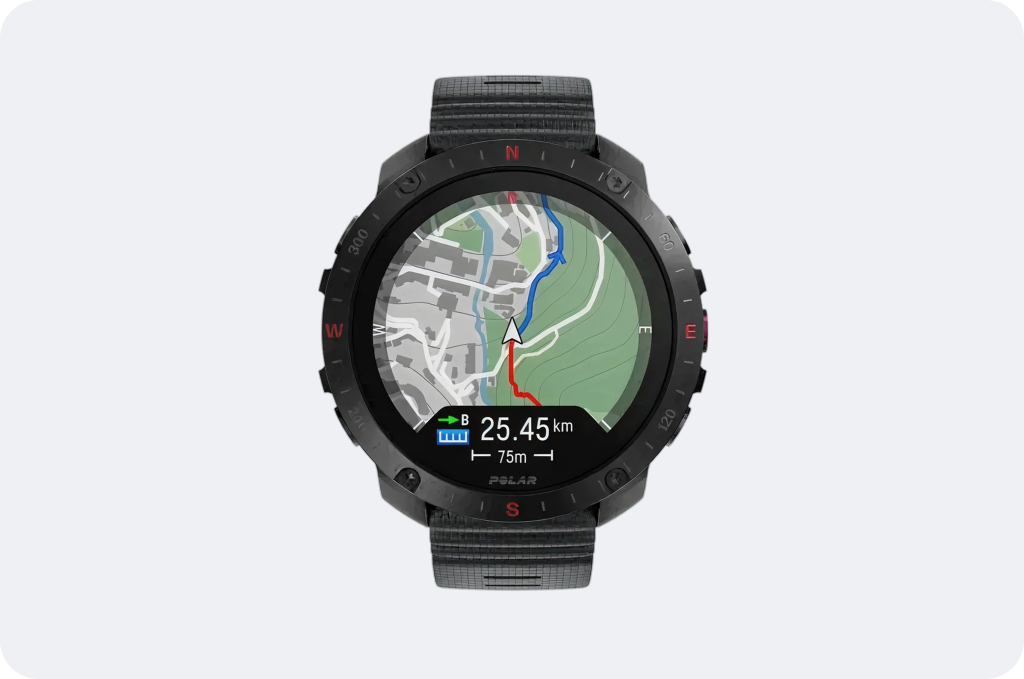
Specifications
- Display: 1.39 in AMOLED, 454 × 454 pixels, touchscreen, always-on option.
- Case dimensions: 48.6 × 48.6 × 13.4 mm
- Weight: 79 g (with strap)
- Battery & Power: 488 mAh Li-Pol rechargeable battery
- Battery life:
- Up to 43 hours with full GPS + heart-rate tracking (Performance training mode)
- Up to 140 hours in Eco / power-saving GPS mode
- Up to 10 days in smartwatch mode (with continuous heart-rate tracking & notifications)
- Water resistance: WR100 — water-resistant up to 100 m (suitable for swimming, etc.).
- Operating temperature range: –20 °C to +50 °C.
- Sensors: Optical heart rate (Gen 4), SpO₂ (Gen 1), skin temperature (Gen 1), ECG (Gen 1), barometer (altitude/pressure), magnetometer/compass, accelerometer, ambient-light sensor.
- GNSS / Navigation / GPS: Dual-frequency GPS plus support for GPS, GLONASS, Galileo, BeiDou, QZSS.
- Connectivity: Bluetooth 5.1 for pairing with phone and sensors, USB-C charging/data cable.
- Memory / Storage: Internal storage (used for maps and data), suitable for storing routes / topo maps.
- Sport & Activity Profiles: Multisport support: running, cycling, hiking, outdoor adventures, swimming, and more, including training, recovery, navigation, sleep and daily activity tracking.
Coros APEX Premium Multisport GPS Watch
The Coros Apex Premium Multisport GPS watch can be used for a wide range of sports activities, including multisports.
The watch has strong sapphire glass that won’t scratch, even during rough sports. Plus, you can customize how it looks, so it’s stylish enough for meetings or parties.
This watch lasts longer on a single charge than any other GPS watch out there. It’s easy to use in any situation because it has a well-designed button that can be pressed with just one finger.
With accurate analysis of training load and performance, you can easily evaluate your workload and receive recommendations for recovery so you can perform your best.
The Coros app provides a comprehensive graphical analysis of your training, including VO2-max, recovery advice, threshold pace, training load for the past seven days, personal fitness index, and much more.
Additionally, you can connect to favorite third-party apps like Diet and Training Peaks and automatically record workouts.
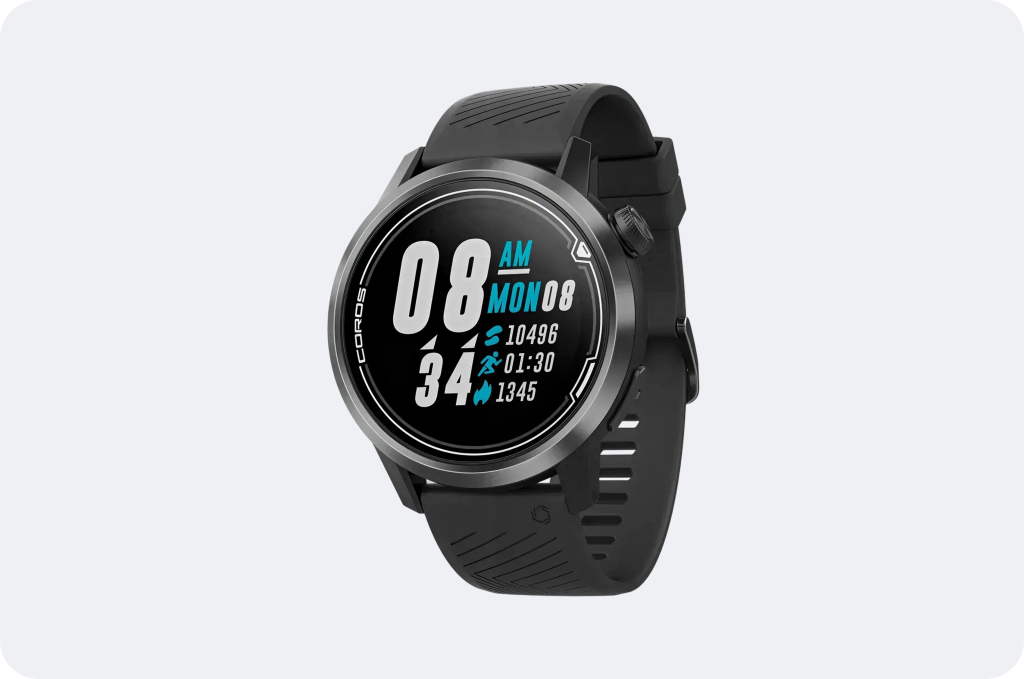
Specifications:
- Sapphire glass
- Ability to zoom in/out with digital keys
- Support for iOS, Android
- GPS navigation
- Time to full charge: up to 2 hours
- Size: 46mm display,1.2″ with a resolution of 240 x 240 (64 colors)
- Display type: LCD
- Dimensions: 48.50 x 48.50 x 13.75 mm
- Wireless connectivity: BT4.2 BLE for smartphones only, ANT+ for accessories
- Navigation: GPS, GLONASS, BDS
- Sensors: Optical heart rate monitor, barometric altimeter, accelerometer, gyroscope, compass
- Waterproof: 10 ATM (100 meters / 328 feet)
- Temperatures: from 14°F to 140°F (-10°C to 60°C), from -4°F to 158°F (-20°C to 70°C)
- Battery: 100 hours in UltraMax GPS mode, 35 hours with GPS, 30 days without GPS
- Supported modes: Running, indoor running, track running, trail running, walking, cycling, indoor cycling, swimming, triathlon, pool, skiing, cross-country skiing, snowboarding, rock climbing, cardio gym, GPS cardio, multisport.
- Price: $349-$380
You can also check out their Coros Pace Pro model. This is their first multisport watch to receive an AMOLED screen, which makes the display significantly brighter and clearer.
Garmin Fenix 8
The Garmin Fenix 8 takes everything people loved about the previous Fenix generation and makes it even smarter, tougher, and more convenient for serious outdoor athletes. Think of it as the watch you choose when you want power, durability, and the full Garmin ecosystem in one place.
The design is still rugged, but it feels more refined. The case is built to handle anything: heat, cold, shocks, rain, and the upgraded scratch-resistant lens helps the battery last even longer, especially with improved solar charging. You spend less time worrying about the battery and more time training, hiking, exploring, or racing.
The Fenix 8 gives you accurate wrist-based heart rate tracking and improved Pulse Ox readings, so you always know how your body responds to effort, altitude, and recovery. It supports everything from long trail runs to indoor workouts with deep performance metrics and plenty of preloaded sport profiles.
One of the most convenient upgrades is the smoother touch interface paired with classic buttons, so you can swipe when it’s easy and click when you’re sweaty, cold, or on the move. The UI feels faster, cleaner, and easier to navigate during training.
The built-in LED flashlight is brighter than before, and it’s surprisingly useful for nighttime runs or finding your way around camp. And just like with the full Garmin Forerunner lineup, you can store music right on the watch and use Garmin Pay for quick, phone-free payments.
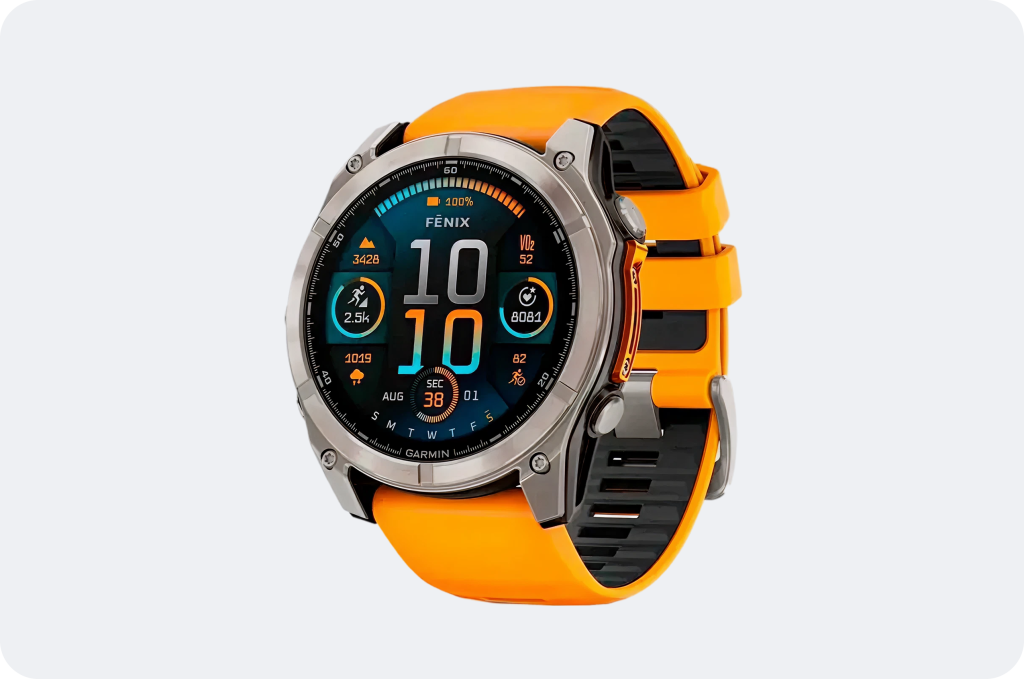
Specifications:
- Case Size: 51 mm
- Battery Life (Smartwatch Mode): Up to 28–37 days with solar
- Battery Saver Mode: Up to 90 days / over 1 year with solar
- GPS Mode: Up to 89–122 hours with solar
- All Satellite Systems: Up to 63–77 hours with solar
- Built-in maps
- Suggested workouts feature
- LED flashlight
- Garmin Pay
- Music onboard storage
- Touchscreen + buttons
- Water resistance: 10 ATM
- Dimensions: 51 x 51 x 14.9 mm
- Weight: 89 g
- Display: 1.4″, 280 × 280 pixels
- Memory: 32 GB
- Sensors: GPS, GLONASS, GALILEO, SatIQ, Elevate HR, Pulse Ox, Barometer, Compass, Gyro, Accelerometer, Thermometer
- Connectivity: Wi-Fi, Bluetooth, ANT+
- Sport profiles: Triathlon, Swim/Run, and many more
- Price: from $999.99
With solar charging, the watch can run up to 22 days in smartwatch mode (assuming 3 hours per day of strong sunlight) and up to 73 hours in GPS mode with solar under ideal outdoor lighting.
Suunto 9 Baro
While Suunto watches may not be as popular as Garmin or Polar, they are highly regarded in performance sports circles. But this is one of the best budget triathlon watch options.
Whether you’re a seasoned triathlete or just starting out, these watches offer ruggedness, precision, and essential training tools for your multisport endeavors.
Suunto 9 Baro isn’t just a GPS watch. It’s a testament to durability and reliability. It can keep track of your location with GPS for up to 7 days straight, matching your endurance every step of the way.
This watch is made for all sorts of sports and is perfect for anyone who needs a tough and dependable sports watch. It is equipped with a clever system that manages its battery life and sends helpful notifications, ensuring it lasts through any activity.
Whether you’re into intense workouts, long races, or daring adventures, Suunto 9 is there to keep up with you.
Specifications:
- Size: 50 x 50 x 16.8 mm / 1.97 x 1.97 x 0.66″
- Weight: 81 g / 2.86 oz
- Materials: Stainless steel, Sapphire glass, Polyamide, fiber-reinforced
- Battery Life in watch mode: 14 days. With continuous tracking and mobile notifications: 7 days. Training mode with GPS: 25 hours / 50 hours / 120 hours / 170 hours.
- Sensors: GPS, GLONASS, Galileo, QZSS, BeiDou, GNSS frequency support.
- Heart rate monitoring.
- Over 80 sport modes are available, covering activities from running and cycling to swimming and skiing.
- Water resistance: 10 ATM
- A touch screen interface.
- Weather-related features.
- Adjust volume, pause, and skip tracks directly from your wrist.
- Monitor fat and carbohydrate burn during exercise.
- Heatmaps: Plan routes using heatmaps in the Suunto app.
- Virtual ghost runner: Practice pacing with a virtual ghost runner.
- Price: from $239.00
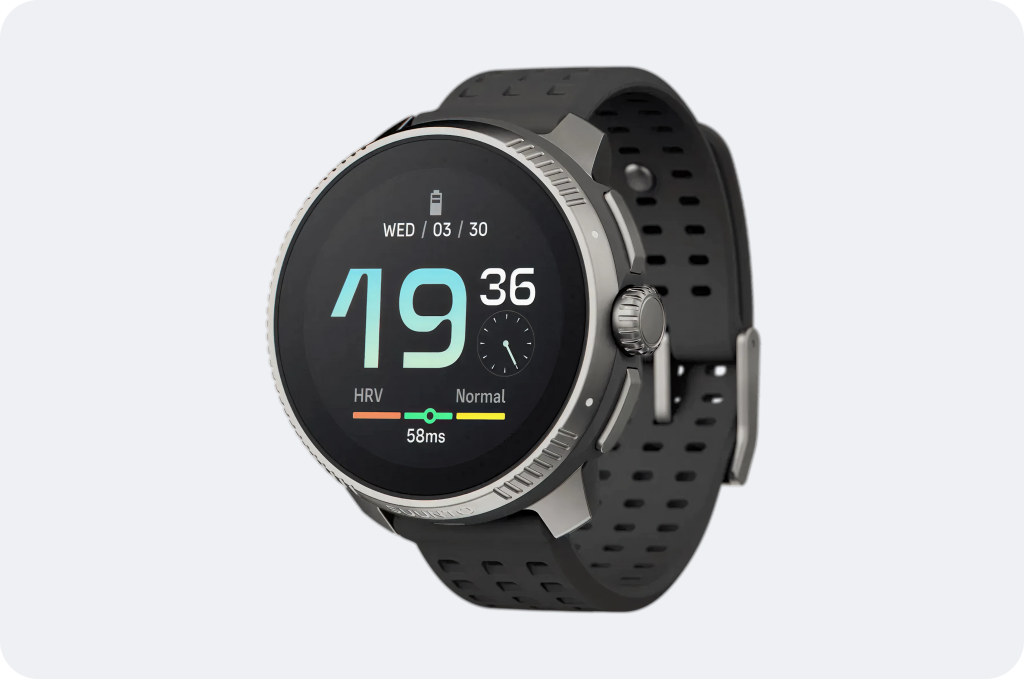
Tested rigorously in tough conditions, Suunto 9 Baro is built to last. It’s been put through its paces by professional athletes and Suunto’s own testing team, enduring thousands of hours of real-world use.
Plus, it meets the strict standards of the US military, so you can trust it to handle low temperatures, impacts, sandstorms, and more.
Suunto Baro 9 watches come packed with features for challenging adventures, like GPS, a barometer, and extensive battery life. And they’re available in different sizes to suit everyone. Made in Finland, they’re reliable and ready for anything.
You can connect your Suunto watch to your favorite apps and share your adventures with the Suunto partner network.
It’s the perfect size and weight for wearing all day comfortably. And it’s built tough, too, with a stainless steel bezel, sapphire glass, and a strong polyamide case.
Suunto Race 2
According to The5kRunner, Suunto Race 2 is one of the best triathlon watches available on the market now. Let’s see why.
Suunto Race is not just another multisports watch. It’s a dependable ally seamlessly integrated into your daily routine.
It monitors your exercise and health, giving you helpful advice and information. Plus, it looks good and works well for both exercise and regular wear.
With Suunto Race, you can expect optimized workouts. Its intelligent analysis of training load, progress tracking, and recovery assessment via heart rate variability (HRV) analysis ensures you’re always on track.
Supported by the Suunto Coach AI feature, you can get personalized advice with just a tap. And it works smoothly with popular apps like TrainingPeaks, giving you full control over your fitness journey.
The vibrant and crisp AMOLED display of the Suunto Race watch guarantees crystal-clear visibility on an always-on display mode even under the blazing sun.
Navigating through menus is a breeze thanks to its responsive 1.43-inch touchscreen, while the intuitive digital crown button on the side adds a touch of convenience. It’s the perfect blend of modern technology and practicality.
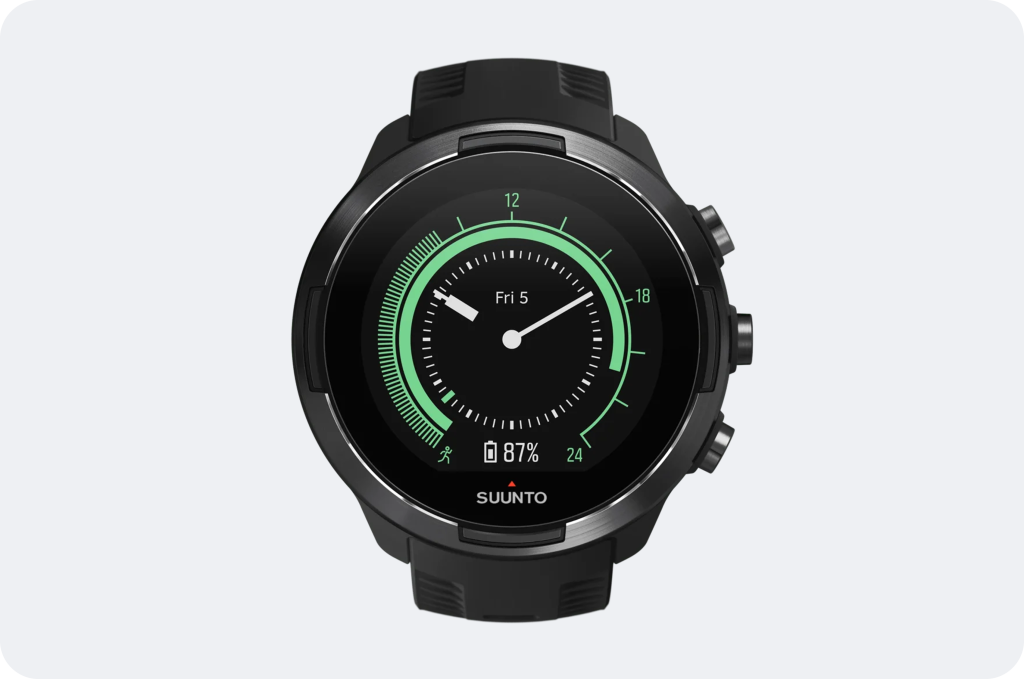
Specifications:
- A high-quality AMOLED screen
- Smart crown button for effortless scrolling
- Endurance tested according to military standards
- Unmatched Battery Life: Opt for the “Performance” mode for up to 40 hours of training. Switch to “Travel” mode during GPS tracking to stretch the battery life up to 5 days.
- 95 sports modes to choose from
- Step-by-step navigation and navigation chains allow you to focus on training while the watch guides your route accurately.
- Heart rate tracking, along with smart notifications, for added convenience.
- Weight 83 g
- Display diagonal: 1.43″
- Button lock, Wireless synchronization, Mobile app integration, Automatic time and date update
- Music player control
- Case size: 49 mm
- Water resistance 10 ATM
- Compatibility: Smartphones with Android 5.0 or later, Smartphones with iOS 12.0 or later
- Activity types: Running, Walking, Fitness, Cycling, Yoga, Swimming, Multisport mode
- Display resolution: 466 x 466 pixels
- Battery life: Up to 40 hours in GPS mode, up to 26 days in normal use
- Sensors: Accelerometer, Barometric altimeter, Barometer, Compass, Pulse oximeter (SpO2), Heart rate monitor, Thermometer
- Price: from $449 (Black) to $549 (Titanium version)
This rugged watch is rigorously tested and built to withstand the harshest conditions without sacrificing style.
Plus, with a battery life of up to 26 days, you’re equipped for extended adventures and intense training sessions without worrying about recharging. Whether it’s a workout session or a regular day, Suunto Race stands as your reliable companion, ready to take on whatever life throws your way.
Amazfit T-Rex 3 Pro
The T-Rex 3 Pro is a rugged multisport smartwatch aimed at people who want a tough, feature-packed watch for outdoor adventures, training, and everyday use, all at a mid-range price.
It comes with a bright AMOLED display and strong materials (titanium bezel + sapphire glass), which make it resistant to scratches and shocks. It supports dual-band GPS with multiple satellite systems — good for accurate tracking during runs, hikes, or cycling.
The watch also brings a wide range of health and performance sensors (heart rate, SpO₂, skin temperature, barometer, compass, etc.), supports many sports modes, and offers navigation tools, offline maps, and turn-by-turn directions. On top of that, it includes handy extras like a built-in LED flashlight, Bluetooth calling (speaker + microphone), and long battery life — useful for long workouts, outdoor trips, or travel.
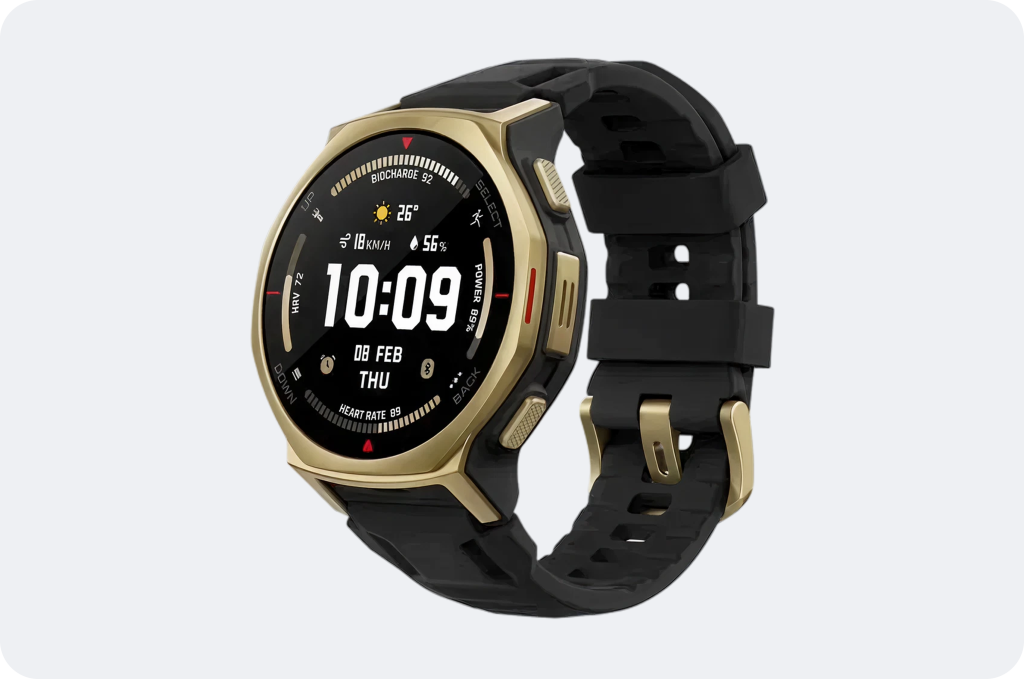
Specifications
- Display: 1.5″ AMOLED (48 mm version) or 1.32″ AMOLED (44 mm version)
- Resolution: 480 × 480 px (48 mm) / 466 × 466 px (44 mm)
- Peak Brightness: up to 3,000 nits — bright enough for direct sunlight
- Glass / Build: Scratch-resistant sapphire glass; Grade 5 titanium bezel and buttons; polymer case body
- Case Size: 48 × 48 × 14 mm (48 mm case) / 44.8 × 44.8 × 13.2 mm (44 mm case)
- Weight: ~52 g (48 mm, without strap) / ~46.8 g (44 mm, without strap)
- Water Resistance: 10 ATM, certified for freediving/ scuba diving up to 45 m (EN13319 / ISO 6425) Battery: 700 mAh (48 mm) / 500 mAh (44 mm) Li-Po battery
- Battery Life (48mm typical use): up to 25 days
- Battery Life (GPS mode): ~38 hours (GPS Accuracy mode, 48 mm) / ~74 hours (power-saving GPS) / up to ~85 hours in “long battery” GPS mode
- Connectivity: Dual-band GNSS GPS (supporting 6 satellite systems), Bluetooth 5.2, Wi-Fi, BLE
- Sensors: BioTracker 6.0 optical heart-rate sensor, SpO₂ (blood oxygen), skin temperature sensor, accelerometer, gyroscope, barometer (altimeter/ pressure), compass, ambient light sensor, temperature sensor
- Sports & Activity Support: 180+ sport modes including hiking, trail running, diving, freediving, cycling, swimming, etc.; supports advanced tracking, route navigation, offline maps, turn-by-turn navigation, route planning, and POI search.
- Extras: Built-in speaker & microphone (Bluetooth calls, voice control with Zepp Flow), two-color LED flashlight (with boost, red light, SOS modes), offline maps & navigation tools, on-watch route planning, real-time navigation, and return navigation support.
- Compatibility: Works with Android (7.0+) and iOS (15.0+) via Zepp App.
Which Garmin Watches are Best for Triathletes?
In this article, we have featured three great Garmins: Forerunner 965, 970, and Fenix 8.
Both these watches stand out as excellent choices for triathletes. They offer all the features you might need in your triathlon training and during races.
However, there are many other Garmin watches that you can choose for a triathlon. For example, the Garmin Forerunner 955 is packed with all the features you might need, including:
- A responsive touchscreen that makes it easy to navigate during intense workouts.
- The solar version harnesses sunlight to extend battery life, ideal for long triathlons.
- Training readiness functionality. This feature helps optimize your training sessions by analyzing your readiness for workouts.
- Impressive battery life: Garmin claims you won’t have to worry about charging mid-race.
Priced from $399.99, it’s a solid investment for triathletes.
Also, the Garmin Instinct and Garmin Enduro series offer a great selection of watches for professional triathletes.
Here are some key features you will benefit from:
- Equipped with preloaded topographic maps and access to GPS, GLONASS, and Galileo satellite systems.
- Advanced metrics like heart rate, VO2 max, and recovery time.
- Crafted from durable slate steel, this watch can handle any weather condition.
- It’s water-resistant, dustproof, and built to last, ensuring it survives all your adventures.
- Battery life lasts up to 14 days in smartwatch mode and 48 hours in GPS mode.
So, if you are thinking about buying a Garmin watch for your training, the options we’ve covered are definitely worth checking out.
What About the Apple Watch?
If you want an all-in-one watch that covers training, everyday life, and keeps you connected, Apple Watch can absolutely work, especially the newer models like Apple Watch Ultra. But if you take triathlon seriously (long distances, reliable data, minimal fuss), it’s worth comparing with other watches from brands built around triathlon.
For a lower price, you can get a dedicated triathlon watch with a longer battery life in GPS and multisport mode, built-in support for swim-bike-run transitions and multisport/training profiles, and other features that justify a hefty price tag.
How do I Choose the Best Triathlon Watch?
Here’s a simple checklist to help you choose the best triathlon watch:
Must-Have Features
- Multisport mode: Lets you record swim → bike → run with one button, treating the whole race as a single activity.
- Open water swim tracking: Must have GPS for swimming in lakes or oceans, not just pools.
- Long battery life: Needs to last longer than your longest race (aim for 15+ hours for a full Ironman).
- Heart rate monitor pairing: Connects to a chest strap (more accurate during cycling than the wrist).
When to Choose New vs. Used vs. Older Model
Choose the new watch if:
- You have the budget and want the latest tech.
- You need a specific new feature (like a new sensor type or map style).
- You race at a high level where marginal gains matter.
Choose the previous version if:
- You want the best value (this is the smart choice for most triathletes).
- A new version just came out, making the older one much cheaper.
- You don’t need the absolute latest features.
Choose a second-hand watch if:
- You’re on a tight budget or just starting out.
- You can verify it’s in good shape (check for screen scratches and ask about the watch’s battery life: does it still hold a charge?).
- You’re okay with no warranty.
Recommendations by Budget
- Low Budget / Beginner: Look for a used Garmin Forerunner 745 or 945, or a new COROS Pace 3.
- Best Value / Most Athletes: Buy a previous-generation model new (like a Forerunner 955 when the 965 comes out).
- No Budget Limits / Serious Racer: Get the latest Garmin Forerunner or Fenix model.
Final tip: The best triathlon watch is the one you can afford that has the multisport mode and battery life you need. You don’t need the newest to train and race effectively.
The Validity of Smartwatch Data for Triathlon: A Study
Smartwatches have become a major fitness trend. They collect more health and movement data than ever. But their accuracy isn’t always reliable.
This study, called Validity of Current Smartwatches for Triathlon Training: How Accurate Are Heart Rate, Distance, and Swimming Readings?, for example, tested ten smartwatches for triathlon training.
They measured heart rates, running and cycling distances, swim stroke rates, and lap counts. Heart rate readings were compared to a chest strap during treadmill intervals with 30 participants. Running and cycling distances were tested on tracks, outdoor routes, and a 36.8 km bike course. Swimming tests included 200–400 m repeats in an Olympic-size pool.
Here is what they’ve got:
Heart rate data
This study tested 10 smartwatches for heart rate, distance, and stroke rate accuracy in running, cycling, and swimming.
Heart rate measurements were divided into average and maximum values. Average heart rates had errors of 3.1%–8.3%, while maximum heart rates were slightly more accurate at 3.1%–7.3%. High heart rates were generally underestimated, and low rates overestimated.
Accuracy also varied between runners. Some showed minimal deviations, while others had large errors up to 17% for average and 24.7% for maximum heart rates.
Wrist-based measurements were less accurate than chest straps. Differences may stem from individual runner movement that affects the optical sensors or timing offsets between watches and reference devices.
The study shows that both the smartwatch model and individual physiology influence heart rate accuracy.
Cycling data
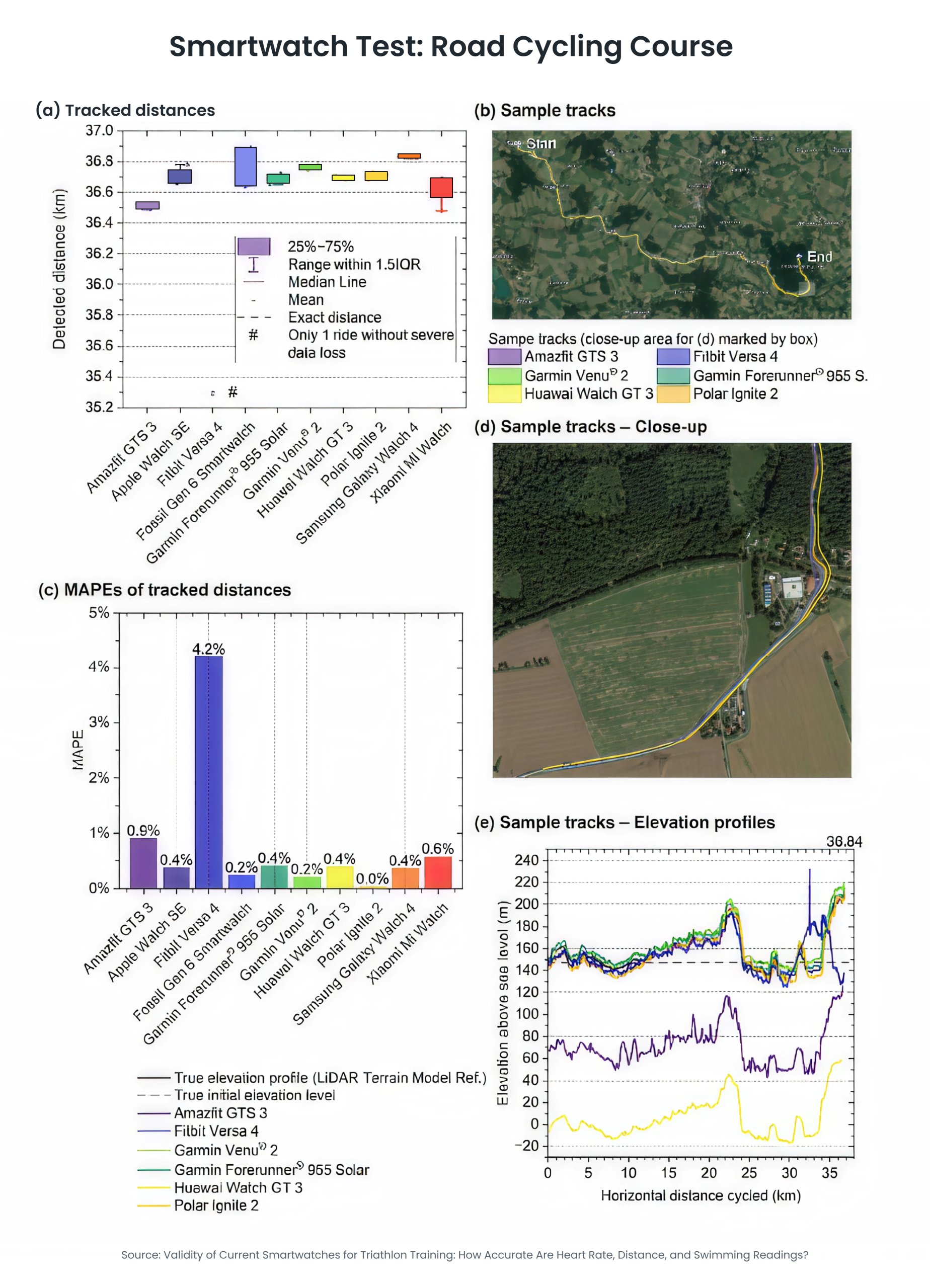
For the 36.8 km road cycling course, all ten watches slightly underestimated the distance but performed better than running GNSS measurements.
Nine watches had MAPEs under 1%, with the POL watch the most accurate at just 0.03%. Seven significant deviations were observed, with large effect sizes, while three watches with fewer valid measurements (POL, FOS, FIT) showed no significant differences.
ANOVA confirmed that the watch model strongly influenced accuracy (η² = 0.775), and post-hoc analysis found 12 significant differences among the ten models.
Elevation measurements were notably inaccurate for AMA and HUA, likely due to altitude offsets and smoothed elevation data.
Running data
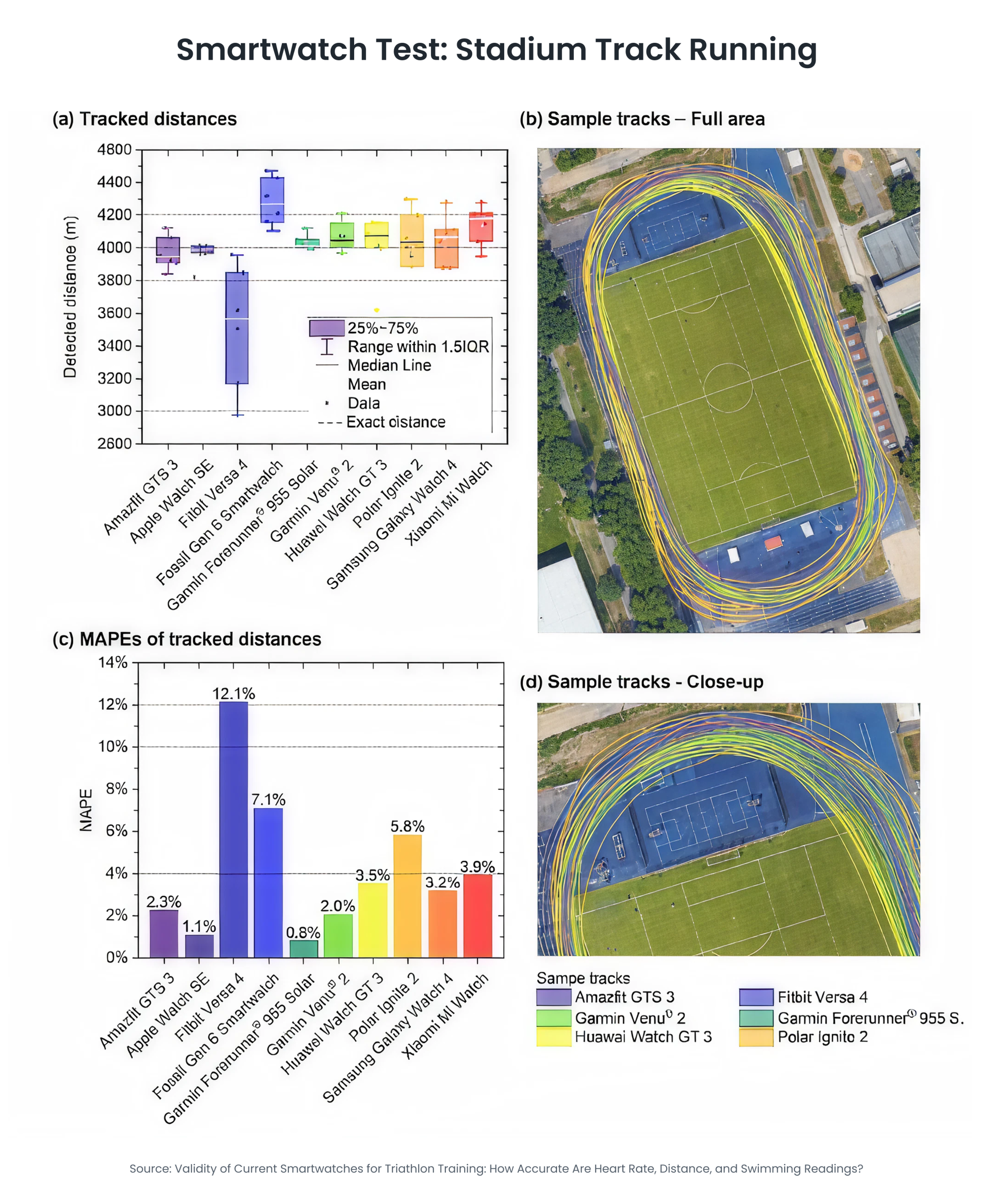
In the 4,000 m stadium track tests, seven of ten smartwatches measured distances within 2% of the true value. Average errors (MAPEs) ranged from 0.8% to 12.1%.
The FIT watch consistently underestimated distance, while FOS and XIA overestimated it, all showing large deviations. ANOVA confirmed that the smartwatch model strongly influenced accuracy (η² = 0.509).
Post-hoc tests found nine significant differences, mainly involving FIT compared to other models. Wrist placement had a minor effect: watches on the inner wrist averaged 3,946 m, and on the outer wrist 4,052 m—a 2.7% difference that was not statistically significant.
Overall, most watches gave reasonably accurate track measurements, but some models showed substantial errors. The findings highlight that both the watch model and individual device behavior can affect running distance accuracy.
Swimming data
Most smartwatches measured the 400 m front crawl distance fairly accurately and correctly counted stroke transitions at the end of each lap.
However, they struggled with frequent stroke transitions, making them unreliable for more complex swim workouts.
Only a few models, specifically HUA and SAM, tracked stroke rate accurately. Overall, current smartwatches can handle simple lap swimming but aren’t suited for more demanding swim drills with frequent changes in stroke type.
Overall, some smartwatches were fairly accurate, especially for long, straight cycling, but many showed substantial deviations in other exercises.
Summing up: What is the Best Triathlon Watch?
Selecting the right watch is essential for optimizing training and race performance.
Multisport watches offer a range of features tailored to the demands of multisport athletes, including water resistance, multisport tracking, GPS functionality, heart rate monitoring, transition timing, long battery life, customizable data screens, and advanced training metrics.
In this guide, we’ve explored the best multisport watches available in 2025, including the Garmin, Sigma, Polar, Coros, Wahoo, and Suunto watches.
Each device offers unique features and benefits suited to triathlon specifics and training needs.
Here are our top triathlon watch picks for 2025:
- Garmin Forerunner 965 is one of the best sports watches overall and the top choice for many thriatheletes.
- Garmin Fenix 8 Solar multisport is an excellent multisport GPS watch featuring an impressive combination of performance, durability, and convenience.
- Sigma Sport iD.TRI – designs specifically for triathlon training.
- Polar Pacer Pro offers accurate data thanks to its Precision Prime™ technology.
- Coros APEX Premium Multisport GPS Watch lasts longer on a single charge than any other GPS watch out there.
- Wahoo Elemnt Rival is the most budget-friendly option. It provides essential data, making it a great option for athletes.
- The Suunto 9 Baro is a durable and reliable GPS watch that lasts up to 7 days on a single charge. It is perfect for any sport or adventure.
- The Suunto Race watch is a great choice for athletes because of its extensive battery life, sleek design, and intelligent training analysis.
- Choose the Garmin Forerunner 955 for accurate performance metrics, long-lasting battery life, and a sleek design that complements your fitness journey
- Garmin Epix (Gen 2 or 3) combines the best of Garmin’s sports tracking technology with a sleek AMOLED display, making it an excellent choice for triathlon pros and enthusiasts alike.
Whether you’re a beginner or a seasoned triathlete, investing in the right triathlon watch is key to achieving your fitness goals and conquering your next multisport event.
Remember that individual preferences and priorities play a role in choosing the best triathlon watch.
Consider factors like budget range, water resistance, multisport tracking capabilities, GPS accuracy, heart rate monitoring, battery life, comfort and fit, data metrics and analysis features, and compatibility when making your decision.
If you are looking for training programs to level up your speed and endurance, feel free to check out our training plans.
Happy training!