
Triathlon swim training is the foundation of a successful race, but it requires a targeted approach, especially for beginners. To perform your best at the swim leg of a triathlon, you need to master both the basics and the specific skills that make triathletes strong in the water.
This swim training guide will focus on:
- Focus first on body positioning, stroke mechanics, and breathing techniques. These are the core pillars of the swim portion.
- Adding endurance sessions (steady swims, pyramid sets), interval and speed work (sprints, tempo sets).
- Technique-focused workouts weekly and vary your sets to maintain progress.
- Practical swim training techniques to help you make the leap from pool to open water.
With a consistent swim training plan and a focus on technique, you’ll quickly notice gains in efficiency and confidence in the water. Let’s dive in, shall we?
Triathlon Swim Training: Why It’s Different
Triathlon swimming is not the same as competitive pool swimming. Here is how swim training for triathletes differs from regular pool swimming:
Energy conservation is key
Pure swimmers race only in the water, then they’re done. You have to bike and run after your swim. This means you can’t give 100% effort in the water like a pool swimmer would. You need to finish the swim feeling strong enough to jump on your bike.
Different swim distances and pacing
Most triathletes swim between 750 meters (sprint distance), 1900 meters (a half Ironman triathlon), and 3,800 meters (Ironman distance). Pool swimmers often race 50 to 1500 meters at maximum speed. Your pace needs to be steady and sustainable for longer distances, not an all-out sprint.
Open water skills matter more
Pool swimmers have lane lines, a black line on the bottom, and clear water. Triathletes swim in lakes, oceans, or rivers with waves, currents, and sometimes poor visibility. You need to learn navigation skills that pool swimmers never practice.
Wetsuit swimming feels different
Most triathlons allow or require wetsuits. A wetsuit makes you more buoyant (you float better) but restricts shoulder-width movement slightly. You’ll need to practice in your wetsuit before race day.
The Importance of Technique in Triathlon Swim Training
How you swim can make or break your race. Technique is everything.
This section focuses on why technique matters so much in swim training for triathlons.
We’ll cover body positioning, stroke mechanics, and breathing technique — key areas that can help you swim faster and smarter. Mastering these basics is essential for success in the water and on the course.
Body Positioning
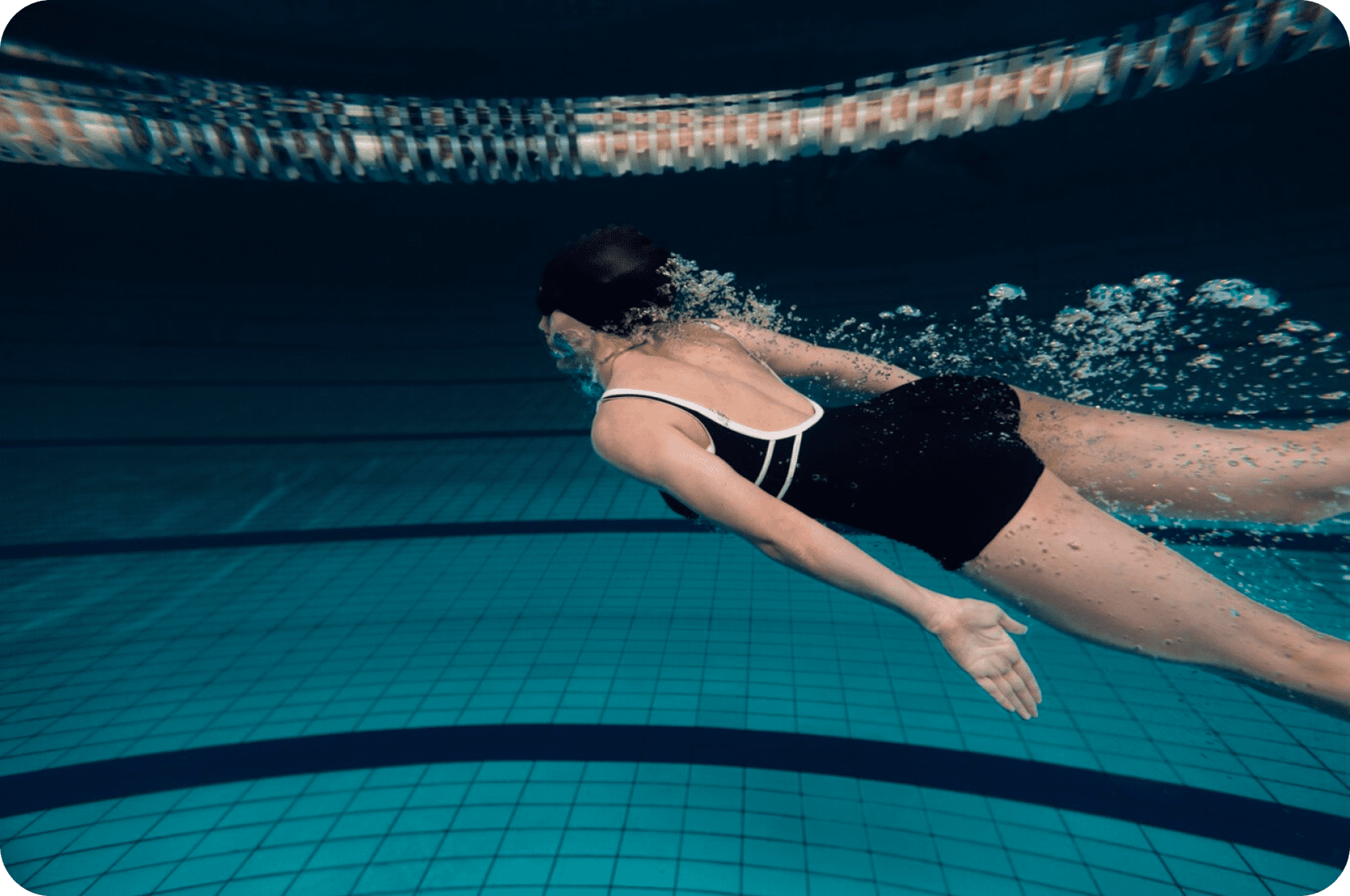
Proper body positioning is crucial for efficient swimming. Starting your first triathlon, whether it is a sprint race or an Olympic distance triathlon, you should focus on achieving the following:
1. Proper alignment
Aim to keep your body in a straight line from head to toe. This reduces drag and improves your swimming speed.
For better positioning, try to imagine you’re a surfboard floating on the water’s surface, with your body extended and aligned.
2. Engaging core muscles
Developing a strong core helps stabilize your body and maintain proper posture throughout the swim.
Stroke Mechanics
Mastering the technique of your strokes is essential for efficient propulsion through the water. Focus on the following aspects:
1. Freestyle stroke breakdown
Break down your freestyle stroke into its key components. Include warm-up, arm movement, body rotation, and stroke technique.
During the arm extended phase, imagine pulling your arm straight back past your hip. Use the entire area of the hand and forearm to maximize pushing.
2. Entry, catch, and pull techniques
Pay attention to the entry of the hand into the water.
Specifically, the gripping phase is when the hand gains traction and the subsequent push moves the body forward.
Imagine your hand entering the water gently, with your fingertips first, followed by a firm grip and pulling the water back towards your hip.
Breathing Technique
Proper breathing technique is vital for maintaining rhythm and efficiency in the water. Consider the following tips:
1. Timing and coordination
Coordinate your breathing with your stroke pattern for smooth and efficient breathing.
Breathe out steadily through your nose and mouth underwater and inhale quickly to the side during the recovery phase of your arm stroke.
2. Bilateral breathing benefits
Incorporate bilateral breathing (breathing on both sides).
This will help improve balance, adaptability, and reduce muscle imbalances.
Practice breathing to the right on one lap and then switch to breathing to the left on the next lap, ensuring balanced muscle development.
Best Swim Drills for Triathlon Training
Here are a few things that will help you create an effective swim training session:
Body Positioning Drills
Drills focusing on body positioning help improve efficiency and reduce resistance in the water, and most importantly, help prevent triathlon injuries. Consider the following drills:
1. Superman glide
Start by pushing off the wall or kicking gently with a kickboard while extending your body into a streamlined position.
Focus on maintaining a straight line and minimizing any unnecessary movements.
2. Kickboard drills
Use a kickboard to isolate your lower body and concentrate on body alignment and kick technique.
Tips: Hold the kickboard with both hands and push off while keeping your face in the water. Maintain a streamlined body position and focus on a confident and powerful kick.
Stroke Technique Drills
Drills that target stroke technique help refine your movements and enhance efficiency.
Try incorporating the following drills:
1. Catch-up drill
Begin by swimming freestyle and pause after each stroke, allowing your recovering arm to catch up with the other arm before starting the next stroke.
This drill helps improve arm extension, timing, and body rotation.
2. First drill
Swim freestyle with your fists closed, without using your hands, to improve your water feel.
In doing so, engage your forearms and overall stroke efficiency.
Clench your fists as if you were gripping something tightly, and swim freestyle. At the same time, focus on maintaining a smooth and powerful forearm stroke.
Here are more tips on dealing with forearm muscle pain for athletes.
Breathing Drills
Your key swim workouts should incorporate exercises that focus on proper techniques and breathing control, contributing to better oxygen consumption.
They also improve overall swimming performance.
Incorporate the following drills:
1. One-goggle drill
Restrict your vision by covering one goggle lens while swimming.
This encourages bilateral breathing and improves body alignment.
Swimming with only one eye, seeing clearly, forces you to rotate and breathe to both sides. Thus enhancing your balance and alignment in the water.
2. Breath control sets
Incorporate breath control exercises into your workouts to improve lung capacity and breathing efficiency.
Swim a certain distance or time, limiting your breaths to every three or five strokes. At the same time, force yourself to increase the distance or time between breaths.
Weekly Swim Training Structure for Beginners and Intermediates
For complete beginners (first 8 weeks)
Swim 2-3 times per week, with at least one rest day between sessions.
- Session 1: Technique focus (30-40 minutes)
- 200m easy warm-up
- 4-6 x 50m with drills (catch-up, fist drill, kickboard)
- 200-400m steady swim, focusing on what you practiced
- 100m easy cool-down
- Session 2: Endurance building (30-45 minutes)
- 200m warm-up
- 3 x 200m at a comfortable pace (30 seconds rest between)
- 200m cool-down
- Session 3 (Optional): Mixed practice (30-40 minutes)
- 200m warm-up with breathing drills
- 400m straight swim at a steady pace
- 4 x 50m faster efforts (focus on form, not speed)
- 200m cool-down
For intermediate swimmers (after 8-12 weeks)
Swim 3-4 times per week.
- Session 1: Technique and drills (45 minutes)
- Session 2: Endurance swim (50-60 minutes)
- Session 3: Speed/interval work (45 minutes)
- Session 4 (Optional): Open water practice or easy recovery swim (30-40 minutes)
Important tips:
- Always warm up for at least 5-10 minutes before hard efforts
- Rest days are when your body gets stronger – don’t skip them
- If you’re tired or sore, do an easy technique session instead of pushing hard
- Quality matters more than quantity
Technique-Focused Sessions: How Often and Why
Even advanced age group champions dedicate time to technique work. For beginners, two technique sessions per week are ideal for the first 2-3 months to become a faster swimmer.
Why technique sessions matter?
When you swim hard or get tired, you often develop bad habits – your form breaks down. Regular technique sessions, even during the off-season, help you:
- Reinforce good movement patterns
- Catch problems before they become habits
- Swim with less effort and more speed
- Reduce injury risk
What does a good technique session look like?
Total time: 30-45 minutes
- Warm-up (5-10 minutes): Easy swimming, focus on feeling relaxed
- Drill Work (15-20 minutes): Pick 2-3 drills and do 4-6 repetitions of each (usually 25m or 50m per repetition)
- Application (10-15 minutes): Swim continuously at easy pace, focusing on applying what you practiced in the drills
- Cool-down (5 minutes): Very easy swimming
You can try to film yourself swimming (ask a training partner, a coach, or set up your phone by the pool). Watching your own stroke reveals problems you can’t feel while swimming.
Open Water Preparation and Race-Day Skills
The pool is comfortable and controlled. Open water is unpredictable. Here’s how to prepare:
Start in the pool. Practice swimming without the black line: Close your eyes for 5-10 strokes, then look. This teaches you to swim straight without visual guides
Then, try to awim in different lanes to build adaptability. Also, you should start practicing with others. Swim next to friends or ask to share a lane. This will help you get comfortable with people near you.
Start with just 5-10 minutes in open water, even if you can swim much longer in the pool. Open water feels different and can be mentally challenging at first, especially in cold temperatures.
Your first open water swims can look like these:
- Go with experienced swimmers or join a group
- Stay close to shore initially
- Wear a bright swim cap so people can see you
- Use a safety pull buoy (floats behind you, doesn’t slow you down)
- Pick calm days with good visibility for your first attempts
Then, build up gradually:
- Week 1-2: Swim parallel to shore, 5-10 minutes
- Week 3-4: Short out-and-back swims, 10-15 minutes
- Week 5-6: Practice sighting and navigation, 15-20 minutes
- Week 7+: Simulate race distance and conditions
How to deal with crowds and mass starts?
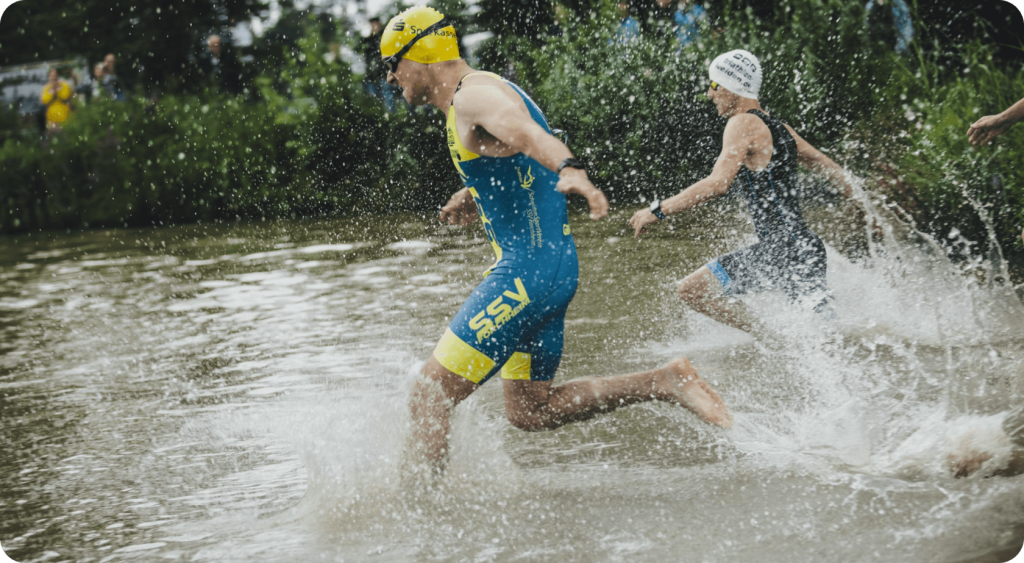
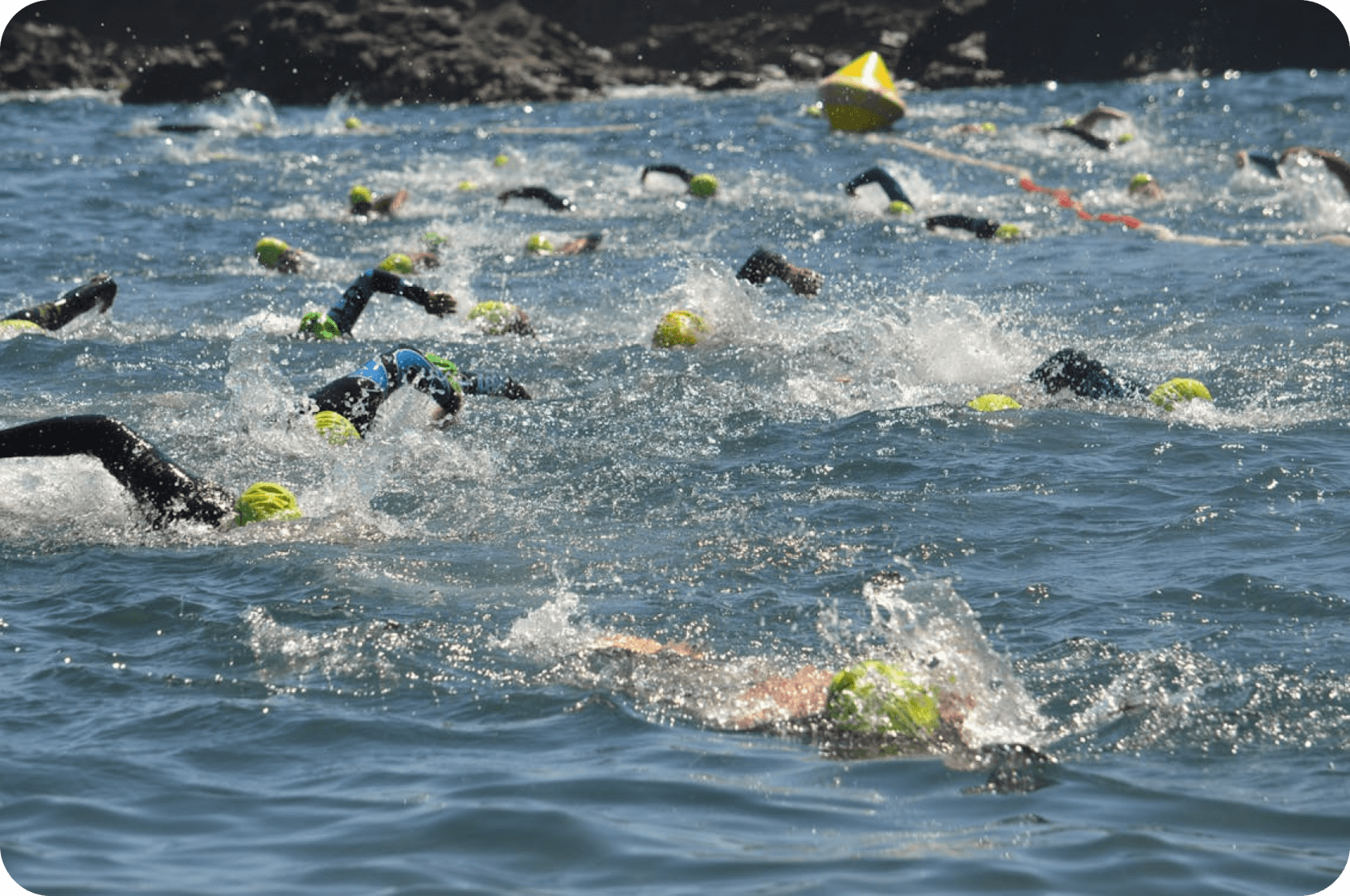
Mass starts can be intimidating and require both body training and mental preparation. Just imagine: hundreds of swimmers enter the water together. It gets really chaotic for the first 200-400 meters.
What to expect:
- Arms and legs everywhere in the first few minutes
- Accidental contact (getting bumped, kicked, swum over)
- Difficulty finding clear water and your rhythm
- Your goggles might get hit or knocked (this one is quite common)
Strategies to handle the chaos:
Start to the side or back
You don’t need to be in front. Starting to the side or 10-20 seconds behind the main group means:
- Less contact with other swimmers
- Clearer water so you can find your rhythm
- You only lose 10-30 seconds, but save a lot of energy reserves and stress
Practice contact swimming
In the pool with friends:
- Swim side-by-side, arms touching occasionally
- Have someone swim over you briefly (safely and consensually)
- Practice having your goggles tapped while swimming
- Deliberately bump into each other gently
This sounds silly, but it prepares you mentally for the real thing.
Stay calm if contact happens
If someone bumps you or you get kicked:
- Don’t panic, it happens to everyone
- Slow down for a few strokes if needed
- Move slightly left or right to find clearer water
- Keep breathing steadily
The first 200 meters matter most
Push slightly harder for the first 200-400 meters to get through the crowd, then settle into your race pace. The chaos usually clears after a few minutes, no matter if it’s an Olympic triathlon or an Ironman race.
Managing Panic and Anxiety in Triathlon Swims
Feeling anxious about the swim is normal, especially for beginners. Here’s how to manage it:
Before race day:
Don’t wait until race day to swim in open water. Practice at least 4-6 times in open water before your first race. Each exposure builds confidence.
Practice your panic response
In the pool or calm open water:
- Swim 25 meters, then stop and tread water for 20 seconds
- Repeat this several times
- Know that you can always stop, float, and breathe
This teaches your brain: “I can stop anytime. I’m safe.”
Visualize success
Spend 5 minutes before bed imagining yourself:
- Swimming calmly in open water
- Handling contact with other swimmers smoothly
- Finishing the swim feeling strong
On race day:
If allowed, swim for 5-10 minutes before the start. This:
- Lets you adjust to the water temperature
- Confirms your goggles fit properly
- Calms pre-race nerves
- Helps you find your breathing rhythm
Start conservatively. The first 100-200 meters should feel easy. Starting too fast when you’re already anxious makes panic more likely.
If panic starts during the race:
- Roll onto your back and float for 10-20 seconds. You won’t sink. Take deep breaths.
- Do backstroke or breaststroke until you feel calm again. Slower is better than panicking.
- Focus on exhaling; panic often comes from not breathing out enough. Make your exhale long and complete.
- Look for a kayak or support boat if you need reassurance. They’re there to help. You can hold onto a kayak to rest (you won’t be disqualified).
- Remember this feeling passes. You’ve practiced for this. Give yourself 30 seconds to reset.
If anxiety is a major issue, consider:
- Taking adult swim lessons with an instructor experienced in triathlon
- Working with a sports psychologist
- Starting with a sprint triathlon (shorter swim)
- Practicing meditation or breathing exercises
Many professional triathletes struggled with swim anxiety early on. You can overcome this with practice and patience.
Common Triathlon Swim Training Mistakes (and How to Avoid Them)
These are swim training mistakes I see quite often, so they must be helpful for you too:
Overlooking Technique for Distance
Many beginners think, “I just need to swim more miles to get better.” They focus on swimming as far as possible each session while ignoring how they swim.
Swimming with poor technique for high volume makes you:
- Reinforce bad habits that are hard to break later
- Get tired faster (poor technique wastes energy)
- Risk of shoulder injuries from repetitive poor mechanics
- Improve slowly or plateau early
The fix:
- Spend 30-40% of your swim time on technique drills and easy swimming
- Every 200-300 meters during longer swims, do 50 meters of drills
- If you’re getting tired and your form is breaking down, stop or slow down
- Remember: swimming 1,000 meters with good technique is better than 2,000 meters with poor technique
How to know your technique needs work?
- You’re breathing heavily after just a few laps
- Your shoulders hurt frequently
- You feel like you’re working really hard but not moving fast
- You can’t swim smoothly at an easy, conversational pace
Ignoring Open Water Skills
Training only in the pool and assuming race day will be the same experience.
Open water is completely different:
- No walls to push off from or rest at
- No black line to follow
- Waves, currents, and changing conditions
- Sighting requires lifting your head, which changes your body position
- Wetsuit feels restricting if you’ve never worn one
The fix:
- Practice open water swimming at least 4-6 times before your race
- Do sighting drills in the pool every week
- Practice swimming without the lane lines (eyes closed for short stretches)
- Wear your swim set in the pool or open water several times before race day
- Join open water swim groups in your area
Not Practicing Race-Day Scenarios
Training in perfect conditions and never simulating what race day will actually be like.
Race day includes:
- Mass starts with lots of contact
- Swimming in a wetsuit
- Sighting every 6-10 strokes
- No rest breaks at the wall
- Transitioning from swim to bike (running out of water, removing wetsuit)
If you’ve never practiced these, race day will be much harder.
Full race simulation:
4-6 weeks before your race, do a complete practice:
- Put on your wetsuit
- Swim the race distance (or 75% of it) in open water
- Practice sighting throughout
- Exit the water and jog 50 meters
- Remove wetsuit
- Note how you feel as this is valuable data
Conclusion
To truly succeed at triathlon swim training, you need to master the swim. If you focus on technique, you’ll start to get that edge. Work on practice targeted drills and stick to workouts that make sense. That’s how the pros are doing it. You’ll end up swimming faster, with a whole lot more confidence in the water, just like the seasoned triathletes out there, the ones who make it look easy.
First things first: get the basics sorted. That means body position, stroke mechanics, and breathing. They’re the cornerstone of it all. Now pick some drills that target whatever is holding you back, maybe your body alignment, or perhaps it’s the way you grab the water. Mix up your workouts the same way pros do: building endurance one day, working on speed another day, and preparing for open water throughout.
The biggest thing, though, is just showing up again and again. Stay open-minded, and you’ll be amazed at the progress you make.
If you are brand new and preparing for your first beginner triathlon race, consider working with a professional coach.
Choosing a triathlon coach who will create a personalized training program will help you improve with every run, cycle, and swim workout.
Frequently Asked Questions
Why is technique so important in triathlon swim training?
Swimming technique is crucial because it directly affects your efficiency in the water.
By mastering proper body positioning, stroke mechanics, and breathing patterns, you can reduce drag, conserve energy, and swim faster, improving your overall performance on a race day.
What are some effective drills for improving swim technique?
There are several drills that can help refine your swim technique.
These include fingertip drag drills for extended arm work (one arm and then the other arm), kickboard drills for leg strength and coordination, and catch-up drills for stroke synchronization.
These drills focus on specific aspects of technique, allowing you to isolate and improve each component of your swim stroke.
How often do I incorporate technique workouts into my training?
Most swimmers include technique-focused workouts in their training plan regularly, ideally at least once or twice a week.
Consistent practice and attention to technique will lead to gradual improvements in your swim performance over time.